


 +86 152 6060 5085
 English
 русский
 español
 português
 العربية
 Polski
- Home
- Products
- News
- Blog
- About Us
- Contact Us

Blog
Catalog
Latest Blog
I. Introduction
In daily life, buttons may seem insignificant, yet they are closely tied to wearer safety. Choking incidents caused by infants and toddlers accidentally swallowing loose buttons occur frequently, while loose buttons on adult clothing not only compromise the user experience but can also lead to embarrassment or even safety hazards. The durability of buttons is one of the key indicators of garment quality.
The Button Snap Pull Tester evaluates the attachment strength between buttons and fabric through scientific and quantitative methods, establishing the first line of defense for garment safety.
II. What Is a Button Strength Tester?
2.1 Equipment Definition and Classification
A button strength tester is a specialized testing instrument used to measure the fastening strength of garment accessories such as buttons, snaps, four-prong snaps, five-prong snaps, and denim buttons. Based on different testing principles, they are primarily divided into two major categories:
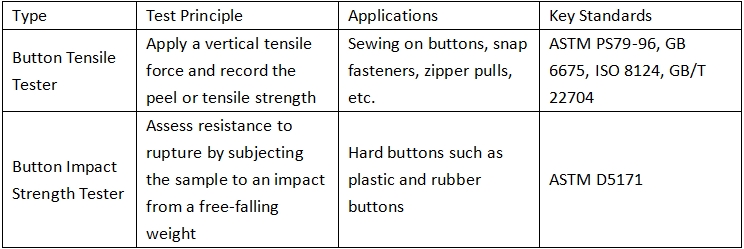
2.2 Structural Components
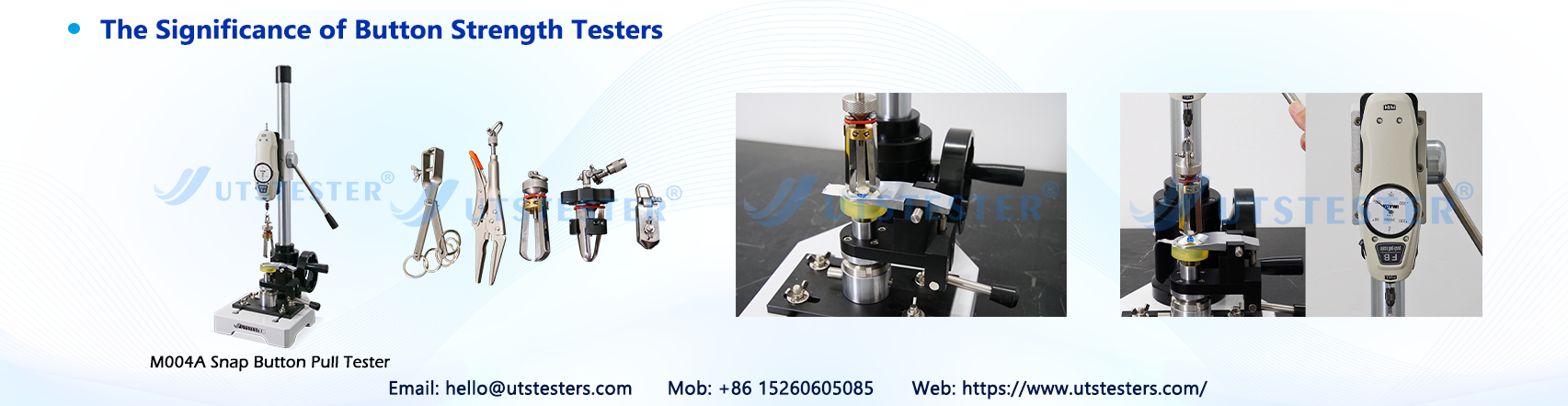
Taking the UTSTESTER M004A Snap Button Pull Tester as an example, it primarily consists of the following components:
1. Concave clawless clamp/button fixture: Used to secure the button component under test
2. Bottom fabric clamp: Securely holds the garment fabric
3. Force gauge/sensor: Displays and records force values in real time
4. Speed control wheel/drive unit: Controls the speed and intensity of the applied tensile force
5. Multi-type adapter fixtures: Includes two-jaw clamps, three-jaw clamps, male button fixtures, female button fixtures, etc., to accommodate different button types
III. Test Principles and Technical Points
3.1 Principle of Tensile Testing
Button tensile testing simulates the tensile forces a button may endure during actual wear. During testing:
1. Secure the garment sample to the bottom fabric fixture
2. Clamp the button assembly using a specialized fixture
3. Apply vertical tensile force at a specified clamping separation rate (typically 100±10 mm/min)
4. Continue applying force until the button detaches, the stitching breaks, or the fabric tears
5. Record the maximum breaking force and failure mode
3.2 Example of Evaluation Criteria
Taking children’s clothing as an example, according to GB/T 22704-2019 “Implementation Specifications for the Design and Production of Children’s Clothing to Improve Mechanical Safety”:
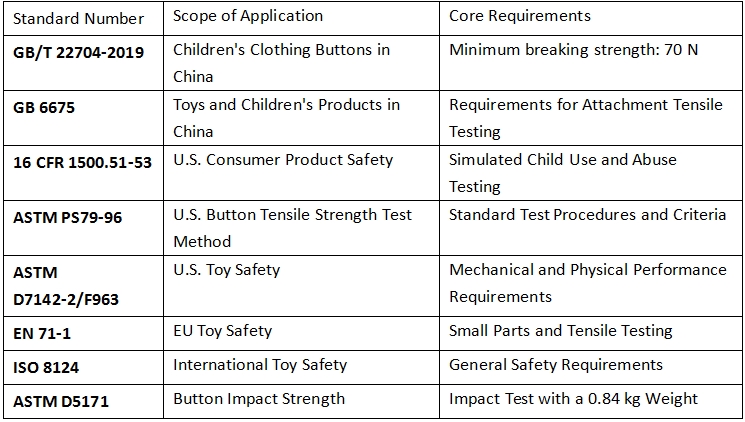
All buttons must withstand a minimum breaking force of 70 N, and no loosening, damage, or stitching slippage may occur during the test. At least 20 buttons of each style must be tested; if even one fails, the entire batch must be retested.
IV. Significance of Application
4.1 Child Safety
Infant and children’s clothing is a top priority for button strength testing. Due to children’s natural tendency to chew on and pull at their clothing, as well as the risk of accidental ingestion of foreign objects, regulations in various countries impose strict requirements on the fastening security of children’s clothing accessories:
1. China: GB 6675 “Safety of Toys,” GB/T 22704 “Buttons for Children’s Clothing”
2. United States: 16 CFR 1500.51-53 (CPSC Mandatory Requirements), ASTM F963
3. European Union: EN 71-1 “Safety of Toys—Mechanical and Physical Properties,” REACH Regulation
4. International: ISO 8124 “Safety of Toys”
These regulations generally require that buttons on children’s clothing must withstand a certain level of tensile force without detaching. The use of a button strength tester helps improve the safety and quality of buttons.
4.2 Quality Control
Button fastening strength depends not only on the quality of the button itself but is also closely related to factors such as sewing techniques, fabric properties, and stitch density. A button strength tester can be used to:
1. Incoming inspection: Verify differences in mechanical properties among different batches of buttons
2. Process Optimization: Compare the impact of different sewing parameters (stitch length, thread type, lockstitch) on fastening strength
3. Finished Product Sampling: Ensure mass-produced items meet customer-specified tensile strength standards
4.3 Extended Applications
By changing fixtures, the button strength tester can also inspect various garment accessories:
1. Zipper Pulls: Test the pull-off strength of zipper pulls with holes
2. Bow Ties and Bows: Evaluate the attachment strength of decorative accessories
3. Appliques and Embroidery: Verify the durability of heat-sealed or sewn-on appliqués
4. Hooks and D-Rings: Test the load-bearing capacity of metal hardware in luggage and footwear
5. Rivets and Denim Buttons: Evaluate the mechanical properties of accessories with specialized manufacturing processes
V. Interpretation of Industry Standards and Regulations
Primary Applicable Standards
VI. Conclusion
While a button strength tester may be just an ordinary piece of equipment in a textile testing laboratory, its significance far exceeds its physical size. From ensuring the safety of infants and young children to safeguarding a brand’s commercial reputation; from meeting international trade compliance requirements to driving quality improvements across the industry—the use of button strength testers embodies the modern textile industry’s unwavering commitment to “safety” and “quality.”
Email: hello@utstesters.com
Direct: + 86 152 6060 5085
Tel: +86-596-7686689
Web: www.utstesters.com

Room 312, Block D, Jiayuan Garden, No.2 Zhongfa Road, Zhangzhou City, Fujian Province, China

+86 152 6060 5085

+86 596 7686689


 hello@utstesters.com
 hello@utstesters.com
 +86 152 6060 5085
 +8615260605085