


 +86 152 6060 5085
 English
 русский
 español
 português
 العربية
 Polski
- Home
- Products
- News
- Blog
- Customer Cases
- About Us
- Contact Us

Blog
Catalog
Latest Blog
In textile production and quality control, shrinkage is a key metric that cannot be ignored. When consumers purchase a shirt or bedding, their most immediate experience often comes from the first wash—whether the size remains stable, the fit holds up, and the texture feels as good as new. The answers to these questions depend largely on whether the fabric underwent rigorous shrinkage testing during the production phase.
In this quality control process, the fully automatic shrinkage tester plays a crucial role.
I. What Is Shrinkage? Why Is It So Important?
Simply put, shrinkage rate is the percentage change in a fabric’s dimensions after washing, drying, or steam treatment. When fibers absorb water, they swell, increasing the diameter of the yarns; this causes the warp and weft yarns to pull on each other and contract. After drying, friction between the fibers prevents the fabric from fully returning to its original state, resulting in a reduction in length or width.
Shrinkage varies significantly among different fabric materials. Synthetic fibers and blended fabrics typically exhibit the lowest shrinkage rates, by wool and linen fabrics, with cotton fabrics falling in the middle. In contrast, regenerated fibers such as viscose and rayon tend to have relatively higher shrinkage rates. For apparel brands, improper control of shrinkage in finished garments can, at best, compromise the wearing experience and, at worst, lead to mass returns and a crisis of brand trust. Therefore, conducting standardized shrinkage rate testing before fabrics leave the factory is an essential step in ensuring product quality.
II. What Is a Fully Automatic Shrinkage Tester?
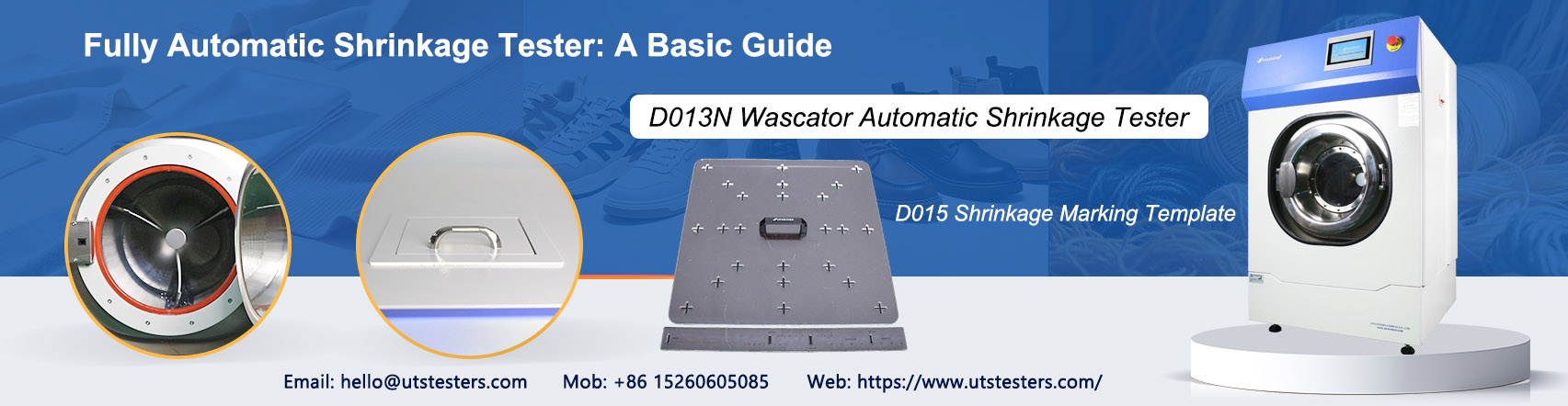
A fully automatic shrinkage tester, also commonly referred to as a fabric shrinkage washing machine or fully automatic fabric shrinkage testing machine, is a specialized device used to precisely measure the rate of dimensional change in textiles after simulated home washing and drying cycles.
Compared to traditional manual testing methods, the most distinctive feature of fully automatic equipment is “end-to-end automation”—from water intake, washing, spinning, and drying to the final dimensional measurement and data calculation, the entire process requires no human intervention. This greatly eliminates errors caused by human operation while significantly improving testing efficiency.
III. Working Principle: How Does It Perform the Test?
The core workflow of a fully automatic shrinkage tester can be divided into three main stages:
Stage 1: Sample Preparation and Marking
Before testing, the fabric to be tested must be cut into standard-sized test specimens, and reference points or reference lines must be marked on the specimens. These markings serve as reference points for subsequent shrinkage measurements. Markings are typically made using a specialized permanent marker or sewing thread to ensure they do not fade or come off during the washing process.
Stage 2: Simulated Washing and Drying
In accordance with the selected test standards (such as GB/T 8629, ISO 6330, AATCC 135, etc.), the instrument automatically executes a preset washing program. The equipment precisely controls key parameters—including water temperature, washing time, drum rotation speed, and spin speed—to simulate a real-world household washing environment. Equipped with heat pump drying technology, it automatically completes the drying process upon test completion.
Stage 3: Automatic Measurement and Data Output
Once processing is complete, the system measures changes in the positions of reference points and calculates the fabric’s shrinkage rates in the warp (lengthwise) and weft (widthwise) directions. Advanced equipment can even complete measurements in just a few seconds and automatically generate test reports containing multiple data points, including shrinkage rates, seam distortion, and diagonal distortion.
IV. Why Choose Fully Automatic Equipment?
High Precision and Repeatability
Utilizing advanced sensors and image processing algorithms, measurement accuracy can reach ±0.1% or higher—far exceeding the error margins of traditional manual measurements. Automated operation eliminates human reading errors, ensuring consistency and traceability of test results every time.
Efficient and Convenient
A single device can process multiple test specimens simultaneously and complete the entire process—from washing to measurement—in a short amount of time.
Compatibility with Multiple Standards
Modern fully automatic shrinkage testers typically come with built-in programs compliant with various international and domestic standards, such as GB/T 8629 “Household Washing and Drying Procedures for Textile Testing,” GB/T 8630 “Determination of Dimensional Changes in Textiles After Washing and Drying,” ISO 6330, ISO 5077, FZ/T 70009, and others. They also support user-defined programs to meet the testing needs of different markets and fabrics of various materials.
Intelligent and Digital
Equipped with a color touchscreen interface and supporting both Chinese and English menus, operation is intuitive and straightforward. Data can be automatically stored and exported.
V. Major Application Areas
Textile Manufacturing and Fabric Companies
Used for incoming raw material inspections, process monitoring after dyeing and printing, and final product inspections before shipment to ensure that fabric shrinkage rates meet customer requirements (e.g., within ±3%). Based on test data, companies can also optimize their pre-shrinking processes and finishing formulas.
Apparel Brands and Manufacturers
During the apparel design phase, shrinkage rate testing is used to optimize cutting dimensions and sewing processes, allowing for a reasonable amount of shrinkage. During the finished garment quality inspection phase, it verifies the product’s wash stability, reducing after-sales risks caused by dimensional changes.
Quality Inspection Agencies and Third-Party Laboratories
These organizations provide authoritative test reports for domestic and international trade, ensuring that exported textiles comply with the regulatory requirements of target markets. The high efficiency of automated equipment also helps significantly shorten testing cycles and improve service response times.
Research and Education
Universities and research institutions use this equipment to conduct research on the shrinkage properties of new fiber materials and eco-friendly fabrics, providing data support for the revision of industry standards and the development of new materials.
Email: hello@utstesters.com
Direct: + 86 152 6060 5085
Tel: +86-596-7686689
Web: www.utstesters.com

Room 312, Block D, Jiayuan Garden, No.2 Zhongfa Road, Zhangzhou City, Fujian Province, China

+86 152 6060 5085

+86 596 7686689


 hello@utstesters.com
 hello@utstesters.com
 +86 152 6060 5085
 +8615260605085