


 +86 152 6060 5085
 English
 русский
 español
 português
 العربية
 Polski
- Home
- Products
- News
- Blog
- About Us
- Contact Us

Blog
Catalog
Latest Blog
Elastic recovery rate is one of the indicators used to measure a fabric’s comfort and durability. Whether it’s intimate apparel, sportswear, high-stretch denim, or medical bandages, elastic performance directly determines a product’s wearability and market competitiveness. In actual testing, the constant elongation method and the constant load method are the two most commonly used test modes; knowing how to select the appropriate method is a skill every testing professional must master.
I. Why Is Elastic Recovery So Important?
Whether a fabric can quickly and fully return to its original state after being stretched is key to evaluating its elasticity. High elastic recovery means the fabric is resistant to deformation and retains its shape well; conversely, low recovery can lead to issues such as sagging and puckering, which affect both appearance and service life.
In practical applications, elasticity requirements vary significantly across different scenarios:
- Tights and swimwear: Require high elasticity and high recovery to maintain a snug fit even after repeated stretching
- Suits and shirts: Require moderate elasticity to ensure freedom of movement while maintaining a crisp, structured appearance
- Denim fabrics: Require a certain degree of elastic recovery to prevent bulging and deformation at the knees
- Medical bandages and compression stockings: Require stable elastic recovery to ensure therapeutic effectiveness
II. Fixed-Elongation Method: A Classic Approach Based on “Deformation”
2.1 Testing Principle
The fixed-elongation method involves stretching a test specimen to a predetermined elongation rate (e.g., 10%, 20%, 30%), holding it for a specified duration, and then releasing it to measure its elastic recovery rate. The core logic is to control deformation and observe recovery.
A typical test procedure is as follows: On a fabric tensile tester, a specimen of specified dimensions is stretched at a constant speed to the target elongation rate, held for a specified duration (usually 1 minute), then retracted at the same speed to zero load. The residual elongation after recovery is recorded, and the elastic recovery rate is calculated.
2.2 Applicable Standards and Scenarios
The fixed-elongation method is widely used in international standards systems, primarily including:
- GB/T 3923.1 “Textiles—Tensile Properties of Fabrics”
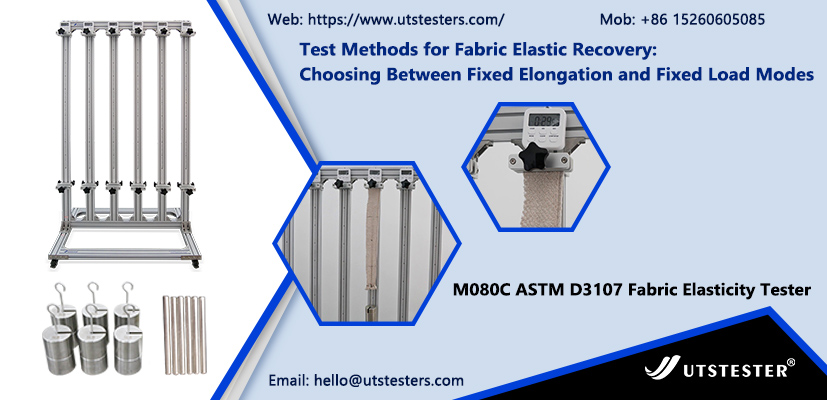
- ASTM D3107 “Standard Test Method for Tensile Properties of Elastic Woven Fabrics”
- ISO 13934-1 “Textiles—Tensile Properties of Fabrics”
This method is particularly suitable for the following scenarios:
- Highly elastic knitted fabrics (e.g., spandex blends): where the recovery capability after significant stretching needs to be evaluated
- Elastic woven fabrics: such as denim and suit fabrics containing spandex
- Scenarios requiring simulation of actual wear-induced deformation: for example, stretching caused by repeated bending at the knees of pants
2.3 Advantages of the Method
The greatest advantage of the fixed-elongation method lies in its intuitive results and good reproducibility. Since the elongation rate is fixed, data from different batches and laboratories are highly comparable, facilitating the establishment of uniform quality standards. Furthermore, this method directly reflects the fabric’s recovery capability under specific deformation, which is highly correlated with the consumer’s actual wearing experience.
III. Constant Load Method: A Practical Approach Based on “Applied Force”
3.1 Test Principle
The constant load method involves stretching a test specimen to a predetermined load value (e.g., 5 N, 10 N, etc.), holding it for a specified duration, then releasing the load to measure its elastic recovery rate. The core logic is to control the applied force and observe the deformation and recovery.
During testing, a specified load is applied to the specimen on a fabric tensile tester; after holding for a specified duration, the load is released, the residual deformation is measured, and the elastic recovery rate is calculated.
3.2 Applicable Standards and Scenarios
The constant-load method is also supported by a comprehensive system of standards:
- FZ/T 01034 “Textiles—Test Method for Tensile Elasticity of Fabrics”
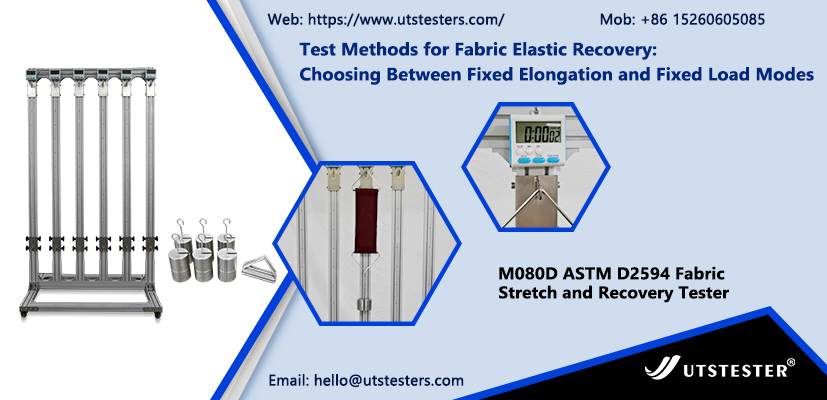
- ASTM D2594 “Standard Test Method for Tensile Properties of Low-Elasticity Knitted Fabrics”
- ISO 20932-1 “Textiles—Determination of Elastic Properties”
This method is more suitable for the following scenarios:
- Low-elasticity or slightly elastic fabrics: such as cotton-spandex blend T-shirts and ordinary knitted fabrics
- Scenarios requiring simulation of specific wearing pressures: such as evaluating the compression effect of compression socks and shapewear
- Woven fabrics with low elasticity: such as ordinary shirt fabrics and casual pants fabrics
3.3 Advantages of the Method
The advantage of the constant-load method lies in its close approximation to actual stress conditions. When a person wears clothing, they perceive “force” rather than “strain.” For example, compression socks apply a fixed pressure (load) to the legs, rather than a fixed amount of stretch. Therefore, the constant-load method can more accurately simulate the actual usage conditions of such products.
Furthermore, for fabrics with low elasticity, the constant-load method prevents sample damage or data distortion caused by forcibly stretching the fabric to a fixed elongation rate, resulting in more stable and reliable test results.
IV. Differences Between the Two Methods and Selection Strategies
4.1 Differences
The fundamental difference between the two methods lies in the variables they control: the constant-elongation method controls the “end point of deformation,” while the constant-load method controls the “end point of force application.” This difference leads to significant variations in testing logic, applicable materials, and the interpretation of results.
From the perspective of testing logic, the fixed-elongation method answers the question: “After a fabric is stretched to a certain extent, how much can it recover?”; the fixed-load method answers: “After a fabric is subjected to a certain force, how much can it recover?” The former focuses on recovery at the limit of deformation, while the latter focuses on recovery under a applied load.
4.2 Selection Strategy
First, consider the product type. For highly elastic products (spandex content > 5%), prioritize the constant elongation method to fully evaluate their recovery capability under large deformations; for low-elasticity or slightly elastic products, prioritize the constant load method to avoid test distortion caused by excessive stretching.
Second, consider the usage scenario. If the product primarily undergoes constant deformation during actual use (such as repeated bending or stretching), select the constant-elongation method; if the product primarily bears constant pressure (such as compression socks or shapewear), select the constant-load method.
Third, consider standard requirements. Standards from different countries and industries have specific provisions regarding testing methods. Exported products must comply with the standards of the target market, while domestically sold products must comply with national or industry standards. Before testing, carefully review the relevant standards to ensure compliance with the specified methods.
Conclusion
The fixed-elongation method and the fixed-load method are not a matter of “which is better or worse,” but rather complementary approaches tailored to different products, scenarios, and requirements. As testing professionals, understanding the differences in the principles and the applicable boundaries of both methods is essential to making the correct choice in practical work and providing enterprises with accurate, reliable, and actionable test data.
About Us
We are a technology company specializing in the R&D and manufacturing of textile testing instruments. Our product range includes a full series of textile testing equipment, such as fabric strength testers, elastic recovery testers, pilling testers, and colorfastness testers. For more product information or technical inquiries, please visit the UTSTESTER official website or contact the UTSTESTER technical team.
Email: hello@utstesters.com
Direct: + 86 152 6060 5085
Tel: +86-596-7686689
Web: www.utstesters.com

Room 312, Block D, Jiayuan Garden, No.2 Zhongfa Road, Zhangzhou City, Fujian Province, China

+86 152 6060 5085

+86 596 7686689


 hello@utstesters.com
 hello@utstesters.com
 +86 152 6060 5085
 +8615260605085