


 +86 152 6060 5085

 English
 русский
 español
 português
 العربية
 Polski

- Home
- Products
- News
- Blog
- Customer Cases
- About Us
- Contact Us

Blog
Catalog
Latest Blog
Leather products are widely used in apparel, footwear, luggage, furniture, and automotive interiors, among other fields, and their quality directly impacts product durability, safety, and user experience. To ensure that leather products meet international standards and consumer expectations, systematic physical and chemical testing is essential.
I. The Importance of Leather Testing
As a natural polymeric material, the properties of leather are influenced by multiple factors, including raw material sources, tanning processes, and finishing treatments. Effective testing can:
- Guarantee product quality: Evaluate key properties such as abrasion resistance, flex resistance, and colorfastness
- Ensure safety in use: Detect residues of harmful substances and meet environmental regulations
- Meet market access requirements: Comply with international and regional standards such as ISO, ASTM, and EN
- Optimize production processes: Provide data-driven support for process improvements at tanneries
II. Physical Property Testing Methods
Physical testing primarily evaluates the mechanical properties, durability, and comfort of leather.
1. Tensile Strength and Elongation Testing
Test Purpose: To evaluate the load-bearing capacity and ductility of leather under stress.
Test Method: Dumbbell-shaped specimens are cut according to standards and stretched to failure at a specified speed on a universal testing machine; the maximum load and elongation are recorded. Top-grain cowhide typically requires a tensile strength of ≥15 MPa, while the elongation varies depending on the application.
Industry Challenge: Upper leather must balance strength and suppleness; test data can guide adjustments to the tanning process.
2. Tear Strength Test
Test Purpose: To measure leather’s resistance to tear propagation, which is particularly important for stress-bearing areas such as shoe uppers and luggage.
Test Method: Using the pant-style tear method or the single-sided tear method, the maximum force required to tear the sample is measured on a testing machine. High-quality leather should have a tear strength of ≥40 N/mm.
3. Flexibility Test
Test Purpose: To simulate the bending deformation of leather products during use and evaluate their fatigue resistance.
Test Method: Secure the test specimen to a flexing tester, repeatedly bend it at a specified angle and frequency, and record the number of flex cycles before cracks or failure occur. Upper leather typically requires a flexing endurance of ≥50,000 cycles without cracking.
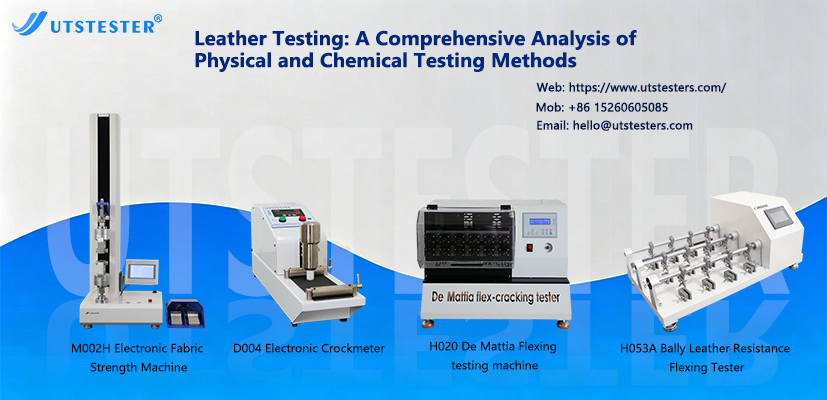
Instrument Selection: The UTSTESTER flexing tester supports a variety of bending angle and frequency settings to accommodate the testing requirements of different leather types.
4. Abrasion Resistance Testing
Test Purpose: To evaluate the leather surface’s ability to resist friction and wear, which directly affects the product’s service life.
Test Method: Using a Martindale or Taber abrasion tester, the degree of surface wear, color change, or mass loss is assessed after a specified load and number of abrasion cycles. Automotive seat leather typically requires abrasion resistance of ≥50,000 cycles without noticeable changes.
5. Color Fastness Testing
Test Purpose: To evaluate the stability of the leather’s color during use, including rub fastness, perspiration fastness, and light fastness.
Test Method:
- Rub Fastness: Rub the leather surface with a standard white cotton cloth under a specified pressure to assess the color transfer rating (typically requiring dry rub ≥ Grade 4 and wet rub ≥ Grade 3)
- Lightfastness: Simulate sunlight exposure through a xenon lamp aging test to evaluate color changes
6. Thickness and Mass per Unit Area
Test Purpose: Basic physical properties.
Test Method: Measure thickness using a leather thickness gauge under standard pressure; calculate mass per unit area by cutting a standard-sized sample and weighing it.
III. Chemical Performance Testing Methods
Chemical testing focuses on the presence of harmful substance residues and the chemical properties of leather.
1. Formaldehyde Content Testing
Testing Background: Formaldehyde is a carcinogen that may remain as a residue from the tanning and finishing processes; regulatory limits are established by various countries.
Test Methods:
- Acetylacetone Method: After water extraction, the sample reacts with acetylacetone to produce a color change, which is then measured using a spectrophotometer.
- High-Performance Liquid Chromatography (HPLC): Offers higher sensitivity and is suitable for detecting low concentrations.
Limit Requirements: China’s National Standard GB 20400 requires that formaldehyde in leather intended for direct skin contact be ≤75 mg/kg; the EU REACH Regulation requires ≤75 mg/kg.
2. Testing for Carcinogenic Aromatic Amines from Degradable Dyes (Azo Dyes)
Testing Background: Certain azo dyes can degrade under specific conditions to produce carcinogenic aromatic amines and have been banned by regulations in many countries.
Test Method: The sample is reduced and hydrolyzed in a citric acid buffer solution, and the content of 24 prohibited aromatic amines is determined using gas chromatography–mass spectrometry (GC-MS) or liquid chromatography–mass spectrometry (LC-MS). The limit requirement is ≤30 mg/kg.
3. Hexavalent Chromium (Cr⁶⁺) Testing
Test Background: Chromium-tanned leather may contain residual hexavalent chromium, which is highly oxidizing and carcinogenic.
Test Method: After extraction with phosphate buffer, the content is determined using the diphenylcarbonyldihydrazine spectrophotometric method or ion chromatography. The EU REACH Regulation requires that the concentration of hexavalent chromium in leather be ≤3 mg/kg.
4. pH and Dilution Difference Determination
Test Purpose: To evaluate the acidity or alkalinity of leather, which affects skin contact safety and storage stability.
Test Method: After extracting the sample with distilled water, the pH of the extract is measured using a pH meter, and the dilution difference (pH difference) is calculated. Generally, the pH must be between 3.5 and 6.0, and the dilution difference must be ≤0.7.
5. Testing for Prohibited Flame Retardants, Phthalates, and Other Substances
Test Background: For leather intended for specific uses, such as furniture and children’s products, restricted substances such as polybrominated diphenyl ethers and phthalates must be tested for.
Test Method: Samples are pretreated using Soxhlet extraction or ultrasonic extraction, by analysis via GC-MS or LC-MS.
6. Resistance to Sweat and Saliva Color Fastness (for Children’s Products)
Test Purpose: To simulate scenarios involving children biting or chewing on products, or contact with sweat, and to assess the risk of migration of harmful substances.
Test Method: Treat test specimens with artificial sweat or saliva simulant to evaluate color migration and the release of harmful substances.
IV. Testing Standards and Regulatory Framework
Leather testing must comply with a multi-tiered standard system:
International Standards: ISO 3376 (Tensile Strength), ISO 3377 (Tear Strength), ISO 11640 (Rubbing Color Fastness), etc.
EU Regulations: REACH Regulation, POPs Regulation, EN 71-3 (Children’s Products)
U.S. Standards: ASTM D2209 (tensile strength), ASTM D1813 (thickness), CPSC Consumer Product Safety Requirements
Chinese Standards: GB 20400 (Limits for Hazardous Substances in Leather), QB/T series of standards
V. Recommendations for Selecting Testing Instruments
Basic Physical Testing: Universal testing machine, fold resistance tester, Martindale abrasion tester, color fastness to rubbing tester
Chemical Analysis Equipment: Spectrophotometer, GC-MS, HPLC, pH meter, leather-specific extraction equipment
Environmental Simulation Equipment: Xenon arc aging chamber, constant temperature and humidity chamber (for pretreatment)
UTSTESTER Solutions: We offer a full range of leather testing instruments covering everything from physical properties to chemical analysis. We support customized standards and method development to help enterprises build comprehensive quality control systems.
For consultations on testing solutions for specific leather types (such as automotive leather, shoe upper leather, and furniture leather), or to learn more about related instruments, please contact the UTSTESTER technical team.
VI. Industry Trends and Outlook
As the concept of sustainability gains traction, leather testing is evolving in the following directions:
- Green chemistry testing: Focus on performance evaluation of bio-based tanning agents and chrome-free tanning processes
- Functional testing: Validation of the performance of functional leathers, such as water-repellent, stain-resistant, and antimicrobial leathers
- Digital quality control: Application of online inspection and big data analysis in the leather manufacturing process
- Circular economy: Quality assessment methods for the recycling and reuse of leather waste
Email: hello@utstesters.com
Direct: + 86 152 6060 5085
Tel: +86-596-7686689
Web: www.utstesters.com

Room 312, Block D, Jiayuan Garden, No.2 Zhongfa Road, Zhangzhou City, Fujian Province, China

+86 152 6060 5085

+86 596 7686689


 hello@utstesters.com
 hello@utstesters.com
 +86 152 6060 5085
 +8615260605085
