


 +86 152 6060 5085
 English
 русский
 español
 português
 العربية
 Polski
- Home
- Products
- News
- Blog
- Customer Cases
- About Us
- Contact Us

Blog
Catalog
Latest Blog
1. Why Do We Need the AATCC 35 Rain Test?
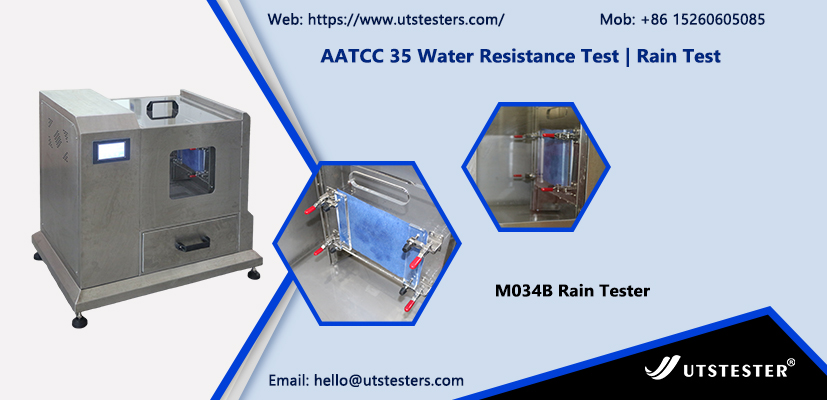
In the development and quality control of outdoor clothing, functional fabrics, and protective gear, "waterproof" is a core metric. But consumers care less about lab data and more about whether the clothing can actually resist sudden rain while being worn. AATCC 35 (Water Resistance: Rain Test) simulates real rain impact scenarios to quantitatively evaluate a fabric's resistance to water penetration under dynamic pressure, making it a key test for predicting actual rainproof performance.
2. Test Principle
A pre-weighed standard absorbent paper is placed behind the specimen, and water is sprayed onto the surface of the specimen at a specific pressure and angle. After a set period, the absorbent paper is weighed again. The difference between the two weights shows the amount of water that has passed through the fabric—the smaller the number, the better the waterproof performance.
The advantage of this method is that the results are objective and measurable. Unlike the spray test that relies on visual observation (AATCC 22), AATCC 35 directly reflects water penetration through the weight gain of the absorbent paper, avoiding subjective judgment bias.
3. Key Test Conditions and Parameters
Sample Preparation: Cut at least three specimens and condition them with the standard absorbent paper under standard atmospheric conditions (temperature 21±1°C, relative humidity 65±2%) for at least 4 hours to ensure consistent test environments.
Spray Parameters: Water temperature should be controlled at 27±1°C, with the nozzle 305mm from the surface of the specimen. Standard spray time is 5 minutes, though some customer agreements may require 2 minutes. Water pressure height can be adjusted according to needs, common levels include 600mm, 915mm, 1220mm, up to a maximum of 2440mm, simulating light rain to heavy downpour.
Result Determination: The average weight gain of the absorbent paper from the three specimens is taken as the final result. If the result exceeds 5.0g, it is usually reported as ">5.0g". For general clothing fabrics, the U.S. market usually requires the absorbent paper weight gain to be no more than 1.0g, and some high-standard scenarios even require ≤0.5g.
4. Differences Between AATCC 35 and Other Waterproof Tests
Within the family of textile waterproof tests, AATCC 35, AATCC 22 (spray test), and AATCC 127 (hydrostatic pressure test) each have their focus:
- AATCC 22 Spray Test: Focuses on assessing the fabric's 'water repellency'—whether water droplets can roll off the surface. It rates the sample by comparing how wet the fabric surface is after spraying against standard reference samples, which is a qualitative or semi-quantitative evaluation.
- AATCC 127 Hydrostatic Pressure Test: Measures the fabric's ability to resist penetration under static water pressure, suitable for items like tents and raincoats that need to withstand some water pressure.
- AATCC 35 Rain Test: Focuses on how much water penetrates under dynamic impact, better simulating the scenario of rain hitting the fabric during actual wear, making it especially suitable for evaluating the water resistance of clothing fabrics.
In short: AATCC 22 checks 'surface water repellency,' AATCC 127 checks 'pressure resistance,' and AATCC 35 checks 'actual water penetration.' The three complement each other, together forming a complete system for evaluating waterproof performance.
5. Key Factors Affecting Test Results
The results of AATCC 35 tests are not just isolated numbers—they are influenced by multiple intertwined factors:
Fiber and yarn water repellency: Natural fibers like cotton are highly absorbent. Even after waterproof finishing, their inherent hydrophilicity can still affect the final performance. Synthetic fibers like polyester and nylon are naturally more hydrophobic, making it easier to achieve lower water penetration.
Fabric structure: A tight plain weave usually blocks water molecules better than a loose knit. However, overly tight fabrics may increase the risk of penetration under dynamic impact due to capillary effects, so a balance in structural design is needed.
Post-treatment processes: The type, dosage, and curing conditions of DWR (durable water-repellent) finishes directly affect the fabric’s waterproof performance. It’s worth noting that uneven coating across different parts of the same fabric can lead to significant variation in test results—something that quality control needs to pay close attention to.
Consistency of test conditions: Minor deviations in water temperature, water pressure stability, nozzle blockage, and ambient temperature and humidity can cause result fluctuations of over 10%. Therefore, using professional testing equipment that is stable and highly automated is crucial.
6. Conclusion
The value of the AATCC 35 rain test is not only in providing a quantifiable "scale" for fabric waterproof performance but also in bridging laboratory data with real-world rainy wearing experiences.
If you want to learn more about the technical specifications or purchasing advice for the AATCC 35 rain tester, feel free to contact the UTSTESTER technical team.
Email: hello@utstesters.com
Direct: + 86 152 6060 5085
Tel: +86-596-7686689
Web: www.utstesters.com

Room 312, Block D, Jiayuan Garden, No.2 Zhongfa Road, Zhangzhou City, Fujian Province, China

+86 152 6060 5085

+86 596 7686689


 hello@utstesters.com
 hello@utstesters.com
 +86 152 6060 5085
 +8615260605085