


 +86 152 6060 5085
 English
 русский
 español
 português
 العربية
 Polski
- Home
- Products
- News
- Blog
- Customer Cases
- About Us
- Contact Us

Blog
Catalog
Latest Blog
Throughout the entire process of textile production and quality control, color stability is one of the most intuitive and sensitive quality indicators for consumers. If a brightly colored garment fades or bleeds after just a few washes, it not only affects the wearing experience but may also directly undermine consumer trust. Wash color fastness testers are the core equipment used to evaluate this critical performance characteristic.
I. Simulating Real-World Washing Conditions
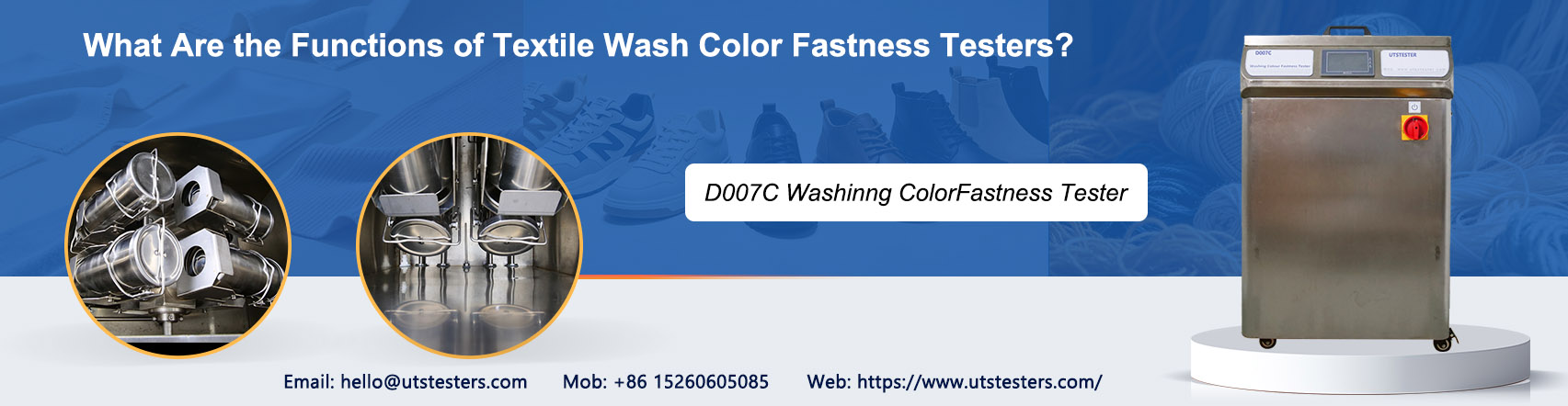
Wash fastness testers precisely simulate everyday washing scenarios under laboratory conditions. The instrument simulates the washing process by sewing or layering the test textile with a standard white backing fabric and placing it in a solution with specific temperature, detergent concentration, and mechanical agitation intensity. During the washing process, stainless steel beads tumble and collide within the container, simulating the agitation and friction exerted by a washing machine on garments. After the test, the degree of color change in the test specimen and the degree of color transfer to the backing fabric are evaluated using color change and color transfer gray scales, resulting in a color fastness rating on a scale of 1 to 5.
This accelerated testing method enables the prediction of a textile’s color performance during long-term practical use within a short period of time, helping companies identify potential fading risks in advance and prevent defective products from entering the market.
II. Covers a Wide Range of Textile Types
The wash fastness tester is not limited to a single material; it has a very broad range of applications. Whether natural fibers such as cotton, wool, silk, and linen, or synthetic fibers such as polyester, nylon, acrylic, and spandex, as well as various blended, knitted, and woven fabrics, all can be tested using this equipment. In addition, it can evaluate the wash fastness of the dyes themselves, providing data support for formulation optimization in printing and dyeing enterprises.
From apparel and home textiles to industrial textiles, virtually all products that undergo a washing process rely on this fundamental and critical test.
III. Support for Multiple Testing Standards
Modern wash fastness testers are typically compatible with major international standards such as ISO 105-C06, AATCC 61, GB/T 3921, JIS L0844, BS 1006, and other mainstream international standards; some high-end devices also support internal testing specifications from brands such as M&S and NEXT.
This means that a single device can help enterprises conduct multi-standard testing for markets in Europe, the United States, Japan, South Korea, and China, significantly reducing laboratory equipment investment costs while ensuring that export products successfully meet the quality requirements of their target markets.
IV. Ensuring Consumer Safety
Textiles with poor colorfastness may release dyes that enter the body through skin contact, posing potential health risks to sensitive individuals, especially infants and young children. In addition, color bleeding from dark-colored garments onto light-colored ones during washing is a common occurrence.
Through rigorous testing with a wash fastness tester, companies can ensure their products comply with environmental and safety regulations , effectively avoiding recalls, claims, and damage to brand reputation caused by quality issues. For close-to-the-skin textiles such as infant and toddler clothing, underwear, and sportswear, this testing is an indispensable part of quality control.
V. Improving Laboratory Efficiency
The UTSTESTER Wash Fastness Tester is equipped with a digital temperature control system, a programmable timer, and a touchscreen interface. It supports real-time display of temperature curves, customizable test program editing, and the storage and export of experimental data.
These features make the testing process more standardized and repeatable, reducing human operational errors. At the same time, its batch testing capability and rapid sample preparation workflow (such as integration with an automatic solution preparation system) significantly increase laboratory testing throughput, meeting the high-frequency testing demands of large-scale production.
Email: hello@utstesters.com
Direct: + 86 152 6060 5085
Tel: +86-596-7686689
Web: www.utstesters.com

Room 312, Block D, Jiayuan Garden, No.2 Zhongfa Road, Zhangzhou City, Fujian Province, China

+86 152 6060 5085

+86 596 7686689


 hello@utstesters.com
 hello@utstesters.com
 +86 152 6060 5085
 +8615260605085