


 +86 152 6060 5085

 English
 русский
 español
 português
 العربية
 Polski

- Home
- Products
- News
- Blog
- Customer Cases
- About Us
- Contact Us
Blog
Catalog
Latest Blog
I. Why Is Color Fastness Testing So Important?
Color fastness is a key indicator of a textile’s color stability and directly impacts the product’s user experience, brand reputation, and market access. A T-shirt that fails color fastness testing may cause an entire load of laundry to become stained after just the first wash; a curtain that does not meet light fastness standards may fade significantly after being exposed to direct sunlight on a balcony for several months.
II. Main Types of Color Fastness Testers
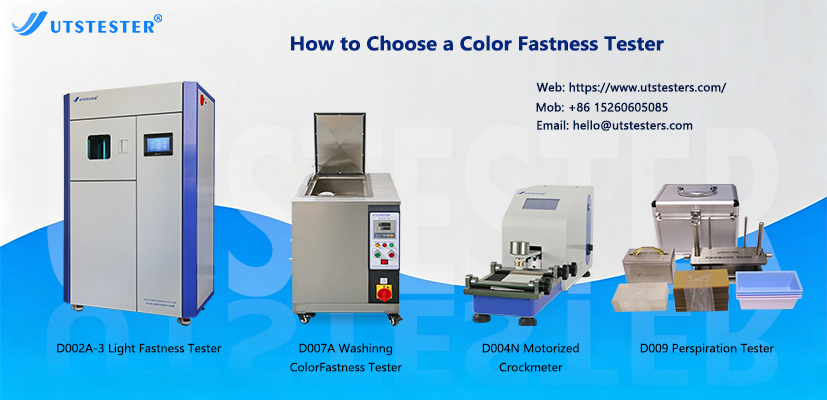
1. Rub Fastness Tester
This is one of the most frequently used pieces of equipment in textile laboratories and is used to evaluate the degree of color transfer from textiles under dry and wet rubbing conditions.
Key Considerations for Selection:
- Rubbing Method: The three mainstream methods currently in use are parallel reciprocating, rotary, and bridge types. The parallel reciprocating method (compliant with GB/T 3920 and ISO 105-X12) is suitable for most conventional fabrics; the rotary method (compliant with AATCC 116) is better suited for precise testing of small-area printed or yarn-dyed fabrics; the bridge method (JIS L0849) involves the most stringent test conditions and is commonly used for testing products exported to the Japanese market.
- Abrasion head specifications: The standard circular abrasion head has a diameter of 16 mm and applies a pressure of 9 N or 11.1 N. When purchasing, verify that the equipment supports the standard requirements of your target market.
- Dry and Wet Testing Capabilities: A high-quality colorfastness to rubbing tester should support both dry and wet rubbing tests. The precision of moisture content control during wet rubbing directly affects test results—the AATCC standard requires 65% moisture content, while the GB/ISO standard requires 95%–100%.
2. Wash Fastness Tester (Water and Soap)
Used to simulate the color stability of textiles during the washing process, this is essential equipment for apparel companies, dyeing and printing mills, and quality inspection agencies.
Key Selection Criteria:
- Steel Cup Capacity: Common specifications include 550 mL and 1200 mL. The 550 mL cup is suitable for ISO 105-C06/E03 or AATCC 61-1A test methods; the 1200 mL cup is suitable for AATCC 61 2A/3A test methods. It is recommended to choose a single-cup or multi-cup configuration based on your testing volume requirements.
- Temperature Control Accuracy: Washing colorfastness testing requires strict temperature control (typically 40°C–95°C), and the temperature control accuracy should be within ±1°C.
- Rotational Speed Stability: The standard rotational speed of the rotating rack is 40 r/min ± 2 r/min; excessive fluctuations in rotational speed can lead to deviations in test results.
3. Lightfastness/Sunlight Fastness Tester
Used to evaluate the color stability of textiles under light exposure, this is crucial for products such as outdoor apparel, curtains, and automotive interiors.
Key Considerations for Selection:
- Light Source Type: Xenon arc lamps are currently the mainstream choice internationally; they can simulate the spectral distribution of natural daylight (D65) and comply with ISO 105-B02 and AATCC 16 standards. Carbon arc lamps have gradually been phased out due to significant spectral deviations, while mercury lamps are primarily used for testing in specific industries.
- Cooling Method: There are two types: water-cooled and air-cooled (including rotary and plate-type). Water-cooled systems are suitable for high-volume continuous testing, while air-cooled systems are lower in cost and easier to maintain. It is important to note that the cooling method itself does not affect the accuracy of test results; the key lies in whether the control precision of irradiance, black panel temperature, chamber temperature, and relative humidity meets the required standards.
- Core Control Parameters:
- Irradiance Control: Should support precise control of 1.1 W/m² at 420 nm or 42 W/m² in the 300–400 nm wavelength band
- Black Panel Temperature (BPT)/Black Standard Temperature (BST): The selection of both types of temperature sensors must comply with the relevant standard requirements
- Relative Humidity Control: Directly affects the repeatability and comparability of test results
4. Sweat Color Fastness Tester
Used to evaluate the color stability of textiles when exposed to human sweat; this is particularly important for intimate apparel such as underwear and sportswear.
Key Selection Criteria:
- The equipment should support both acidic and alkaline sweat test conditions
- The weight-loading device must be precise (typically 50 N or 10 pounds)
- The temperature range of the accompanying oven should cover room temperature to 90°C
III. Five Core Principles for Selecting a Color Fastness Tester
Principle 1: Define Your Testing Objectives
- What are your main products? Cotton, wool, silk, linen, synthetic fibers, or blends? Different fibers require different types of dyes and have varying colorfastness requirements. For example, cotton fabrics dyed with reactive dyes generally have good wash fastness but often exhibit weaker rub fastness (especially wet rub fastness); conversely, polyester fabrics dyed with disperse dyes exhibit the opposite characteristics.
- Which markets do you primarily sell your products to? European and American markets typically require AATCC standards, while Europe and most of Asia adopt ISO standards, and the domestic market primarily follows GB/T standards. These standards differ in testing conditions and rating methods, so equipment must be compatible with the standard requirements of the target market.
- Which colorfastness tests do you need to conduct? Do you only need rub and wash fastness, or do you need to cover the full range of tests, including lightfastness, perspiration resistance, dry-cleaning fastness, and sublimation resistance?
Principle 2: Prioritize Standard Compatibility
List of Key Standards:
- International Standards: ISO 105 series (covering rubbing, washing, light, perspiration, etc.)
- U.S. Standards: AATCC 8 (rubbing), AATCC 61 (washing), AATCC 16 (light exposure), AATCC 15 (perspiration)
- Chinese Standards: GB/T 3920 (rubbing), GB/T 3921 (washing), GB/T 8427 (light exposure), GB/T 3922 (sweat)
When selecting a tester, ensure that its parameter settings, test procedures, and result rating methods strictly correspond to the target standards.
Principle 3: Focus on the Accuracy and Stability of the Control System
Key Focus Areas:
- Irradiance Control: For sunlight colorfastness testers, the stability of irradiance directly determines the reliability of test results. High-quality equipment should be equipped with a closed-loop irradiance control system capable of monitoring and automatically adjusting light source output in real time.
- Temperature and Humidity Control: Fluctuations in temperature and humidity can significantly affect the photodegradation and hydrolysis rates of dyes. Control accuracy should meet the following standards: temperature ±1°C, relative humidity ±3%RH.
- Level of Automation: High-end models support digital parameter settings, automatic timing, real-time data logging, and anomaly alarms, which not only reduce human operational errors but also significantly improve testing efficiency.
Principle 4: Evaluate the Equipment’s Expandability and Compatibility
A good colorfastness tester should offer excellent expandability:
- Multi-standard switching: Supports quick switching between different testing standards to accommodate diverse customer needs
- Modular design: Certain test items can be performed by replacing accessories or modules; for example, a rub fastness tester can adapt to different standards by replacing the rubbing head
- Data interfaces: Supports USB, RS232, or Ethernet interfaces to facilitate the export, storage, and traceability of test data
Conclusion
Selecting a colorfastness tester is not simply a matter of “buying a piece of equipment”; it is about establishing a reliable quality assurance system for your business. UTSTESTER recommends that when making your selection, you should not focus solely on price, but rather conduct a comprehensive evaluation based on four key factors: compliance with standards, testing accuracy, ease of use, and after-sales service.
If you have any questions during the selection process, please feel free to contact the UTSTESTER technical team at any time. We will provide professional product selection advice and technical support tailored to your specific needs.
Email: hello@utstesters.com
Direct: + 86 152 6060 5085
Tel: +86-596-7686689
Web: www.utstesters.com

Room 312, Block D, Jiayuan Garden, No.2 Zhongfa Road, Zhangzhou City, Fujian Province, China

+86 152 6060 5085

+86 596 7686689


 hello@utstesters.com
 hello@utstesters.com
 +86 152 6060 5085
 +8615260605085
