


 +86 152 6060 5085
 English
 русский
 español
 português
 العربية
 Polski
- Home
- Products
- News
- Blog
- Customer Cases
- About Us
- Contact Us

Blog
Catalog
Latest Blog
Surface water repellency (water beading rating) is one of the most intuitive and commonly used indicators for measuring a fabric’s water-repellent performance. Whether for outdoor jackets, medical protective clothing, or everyday casual fabrics, water-repellent performance resembling the “lotus effect” relies on precise spray test evaluations.
I. What Is a Spray Test?
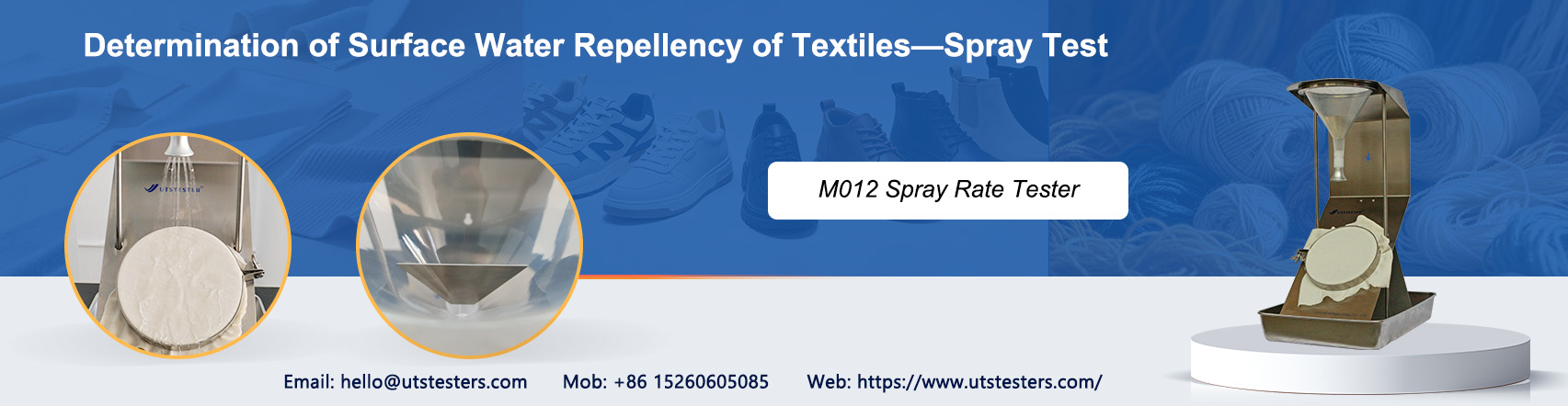
The spray test is a rapid testing method that simulates a rain shower to evaluate a fabric’s surface resistance to liquid water. The core principle involves spraying water onto the fabric surface in a specific manner and determining the fabric’s water-repellency rating by observing the degree of wetting.
It is important to note that the spray test measures surface water repellency, not the fabric’s water absorption rate or resistance to rain penetration. In other words, even if a fabric achieves the highest rating in the spray test, it does not necessarily mean it can prevent rainwater from penetrating under pressure—this is the question addressed by the hydrostatic pressure test (GB/T 4744).
II. Compliance with Standards
GB/T 4745, “Textiles—Testing and Evaluation of Water Repellency—Spray Method,” is equivalent to the international standard ISO 4920. This standard applies to all types of fabrics, whether or not they have undergone water-repellent or water-resistant finishing.
ISO 4920:2012, published by the International Organization for Standardization, is titled “Textiles—Determination of resistance to surface wetting (spray test)” and is highly consistent with GB/T 4745 in terms of technical content; it is a standard frequently cited in export trade and international certification.
AATCC 22 is the spray test standard established by the American Association of Textile Chemists and Colorists (AATCC). Its rating system uses a 0–100 point scale, which corresponds to the 1–5 grade system of GB/ISO (for example, Grade 5 under the national standard corresponds to 100 points on the AATCC scale).
III. Test Principle
During the test, mount the specimen on a ring-shaped clamp so that the fabric’s right side faces upward and is positioned at a 45° angle to the horizontal plane. The center of the specimen should be directly below the nozzle, 150 mm away. Next, pour distilled or deionized water quickly and steadily into the glass funnel; the water is sprayed evenly onto the specimen’s surface through the nozzle. The entire spraying process lasts approximately 25–30 seconds.
IV. Rating Criteria
After the spraying is complete, the operator must quickly remove the clamp along with the specimen, positioning the fabric’s right side so that it is nearly horizontal. The operator then gently taps the specimen once at each of two points radially opposite on the frame. Finally, the specimen is rated based on its degree of wetting by comparing it to the standard images.
GB/T 4745 classifies water wetting levels into grades 1 through 5:
Grade 5: The sprayed surface is completely unwet, with no water droplets adhering to it—this represents the ideal “lotus effect.”
Grade 4: The sprayed surface is unwet, but small water droplets adhere to it—the droplets remain on the surface without spreading.
Grade 3: The surface shows only small, unconnected areas of wetting—scattered wetting spots appear.
Grade 2: Half of the surface is wetted—typically manifested as the sum of small, unconnected wetted areas.
Level 1: The entire surface is wetted—the water has spread completely and penetrated the fabric surface.
For dark-colored fabrics, due to insufficient contrast in the standard images, grading is based primarily on the textual description rather than the images. At least three samples must be taken for each test, cut from different areas of the fabric. Avoid creases and folds, and minimize handling after sampling to prevent oils from the hands from affecting the fabric’s wetting properties.
V. Industry Value of the Water Beading Test
Due to its simplicity, intuitive results, and low cost, the water beading test has become an indispensable tool for quality control and product development in the textile industry. For fabrics treated with fluorocarbon compounds, silicones, or other water-repellent finishes, the water beading grade serves as the quickest indicator for evaluating the effectiveness of the finish. At the same time, it is the performance parameter that consumers find easiest to understand—a fabric with a water beading rating of Level 5 means that rainwater will roll off it just as it does on a lotus leaf, without immediately wetting the garment.
Accurate water beading tests not only help companies control product quality but also provide consumers with reliable performance guarantees.
Email: hello@utstesters.com
Direct: + 86 152 6060 5085
Tel: +86-596-7686689
Web: www.utstesters.com

Room 312, Block D, Jiayuan Garden, No.2 Zhongfa Road, Zhangzhou City, Fujian Province, China

+86 152 6060 5085

+86 596 7686689


 hello@utstesters.com
 hello@utstesters.com
 +86 152 6060 5085
 +8615260605085