


 +86 152 6060 5085
 English
 русский
 español
 português
 العربية
 Polski
- Home
- Products
- News
- Blog
- Customer Cases
- About Us
- Contact Us

Blog
Catalog
Latest Blog
I. What Is Fabric Crease Recovery?
Fabric crease recovery (also known as wrinkle recovery) refers to a fabric’s ability to automatically return to a smooth, flat state after creases are formed by external folding forces. This property directly affects a garment’s ability to maintain its appearance and its wrinkle-resistant qualities, making it one of the key indicators of fabric quality.
In everyday life, the core technical indicator behind concepts such as “non-iron shirts” and “low-maintenance fabrics” is crease recovery. Excellent crease recovery performance means:
Fabrics do not develop noticeable wrinkles easily after wearing; they require little or no ironing after washing; and they maintain a smooth, crisp appearance over the long term.
II. Testing Principles of Crease Recovery
2.1 Testing Mechanism
Crease recovery testing simulates the folding-recovery process of fabric during actual use:
1. Applying deformation: Fold the fabric sample according to specified procedures, apply a standard pressure (typically 500g), and maintain it for a set duration (typically 5 minutes)
2. Releasing stress: After removing the pressure, allow the sample to recover freely
3. Measure the recovery angle: Measure the angle between the sample’s folded surface and the horizontal plane (recovery angle); a larger angle indicates better recovery.
2.2 Two Main Testing Methods
Horizontal Method: The sample is folded horizontally, and vertical pressure is applied; this is the method commonly used in international standards.
Vertical Method: The sample is folded while suspended vertically; this method is required by specific standards.
III. Detailed Explanation of Testing Standards
BS EN 22313 / ISO 2313
- Specifies the test procedure for the horizontal method
- Applicable to all types of woven fabrics
- Test conditions: 500 g pressure, 5-minute loading time
AATCC 66
- Uses the vertical method for testing
- Widely used in the North American market
- Data differs from the ISO method; direct comparison is not possible
GB/T 3819
- Equivalent to ISO 2313
- Applicable to crease recovery testing of all types of textiles
- The mainstream method in China’s textile testing laboratories
IV. Testing Equipment and Operating Procedures
4.1 Core Equipment
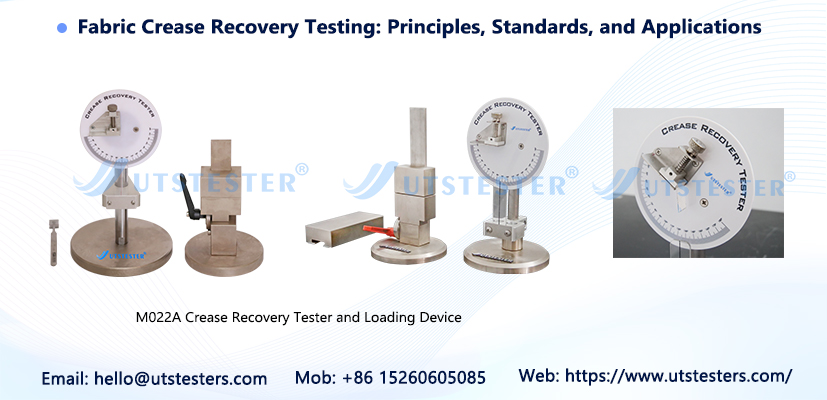
Components of the Crease Recovery Tester
Pressure Application Device: Precision pressure weight (500 g ± 5 g)
Timing System: Precise control of pressure application and recovery times
Angle Measurement: Dedicated protractor or digital measurement system
Environmental Control: Standard atmospheric conditions (20 ± 2°C, 65 ± 2% RH)
4.2 Standard Test Procedure
Step 1: Sample Preparation
Cut test specimens of specified dimensions from the sample; take several specimens in both the warp and weft directions (typically 5 each); condition them under standard atmospheric conditions for at least 24 hours.
Step 2: Folding and Pressing
Fold the specimen in half with the right side facing inward (or as required by the standard); place it in the pressing device and apply a pressure of 500 g; maintain this pressure for 5 minutes ± 5 seconds.
Step 3: Free Recovery
Quickly release the pressure and transfer the test specimens to the recovery device; allow the specimens to recover freely for 5 minutes ± 5 seconds
Step 4: Angle Measurement
Measure the angle between the two surfaces using a dedicated protractor; record the recovery angle value (accurate to 1 degree)
Step 5: Result Calculation
Calculate the average recovery angle for the warp and weft directions separately; calculate the total recovery angle (warp + weft) if necessary
V. Key Factors Affecting Crease Recovery
5.1 Fiber Factors
Polyester (polyester fiber): Excellent recovery, high elastic modulus, and molecular chains that readily return to their original shape
Wool: Good recovery, excellent elastic recovery properties
Nylon: Moderate recovery, performance decreases significantly after moisture absorption
Cotton: Poor recovery, high rigidity of cellulose molecules, prone to forming hydrogen bonds that fix creases
Rayon: Poor recovery, low wet modulus, extremely prone to wrinkling
5.2 Fabric Structure Factors
Fabric Density: Denser fabrics generally exhibit better recovery
Yarn Twist: High-twist yarns help improve recovery
Fabric Weave: Plain < Twill < Satin (recovery increases in this order)
Fabric Thickness: Thinner fabrics are more prone to permanent wrinkles
VI. Application and Interpretation of Test Results
6.1 Classification of Recovery Angle Grades (for reference)
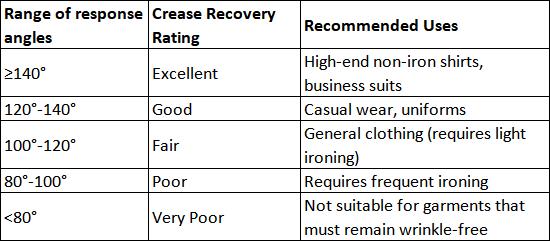
6.2 Anisotropy Analysis
The recovery angles of a fabric’s warp and weft directions often differ:
1. High warp recovery angle: Indicates good wrinkle resistance in the longitudinal direction.
2. High weft recovery angle: Indicates good wrinkle resistance in the transverse direction.
3. Significant difference between the two: Suggests that the fabric may have uneven weaving or finishing.
6.3 Practical Application Guidelines
Recommendations for apparel manufacturers:
1. Business shirt fabrics: Recommended total recovery angle (warp + weft) ≥ 250°
2. Casual pants fabrics: Recommended total recovery angle ≥ 220°
3. Home textile products: Recovery angle requirements may be appropriately relaxed
VII. Frequently Asked Questions and Solutions
Q1: Why do test results for the same fabric vary when tested multiple times?
Possible causes:
1. Insufficient acclimatization of the test specimen
2. Differences in sampling location (performance varies between the fabric edge and the center)
3. Inconsistent testing procedures (application and release speeds)
Solution: Strictly adhere to standard conditions, increase the number of test specimens, and calculate the average
Q2: How should data from ISO methods be converted to AATCC methods?
Note: The two methods are based on different principles, so there is no exact conversion formula. Recommendations:
1. For exports to Europe and the U.S.: Prioritize AATCC 66 testing
2. For general trade: Use ISO 2313 or GB/T 3819
3. For internal quality control: Use a single method consistently and establish a company database
Q3: How can fabric crease recovery be improved?
Technical approaches:
1. Select fibers with inherent elasticity (e.g., polyester-spandex blends)
2. Optimize fabric structure (appropriately increase density)
3. Apply resin finishing or liquid ammonia finishing
4. Develop new types of elastic composite yarns
Email: hello@utstesters.com
Direct: + 86 152 6060 5085
Tel: +86-596-7686689
Web: www.utstesters.com

Room 312, Block D, Jiayuan Garden, No.2 Zhongfa Road, Zhangzhou City, Fujian Province, China

+86 152 6060 5085

+86 596 7686689


 hello@utstesters.com
 hello@utstesters.com
 +86 152 6060 5085
 +8615260605085