


 +86 152 6060 5085
 English
 русский
 español
 português
 العربية
 Polski
- Home
- Products
- News
- Blog
- Customer Cases
- About Us
- Contact Us

Blog
Catalog
Latest Blog
In the field of industrial safety, a pair of compliant safety shoes not only provides a comfortable wearing experience but also serves as a vital line of defense for protecting workers’ lives. Excessive sole wear is the primary cause of reduced protective performance. This article will provide a detailed overview of professional testing methods for assessing the slip resistance and durability of safety shoes.
I. Slip Resistance Testing
1.1 Why Is Slip Resistance Testing Critical?
Slip resistance is one of the core safety indicators for safety shoes. On wet, oily, or slippery surfaces, the sole’s coefficient of friction directly determines whether the wearer is prone to slipping. According to the requirements of international standards ISO 20345:2022 and EN ISO 20347:2022, safety shoes must pass rigorous slip resistance rating tests to be labeled with the slip resistance (SR) rating on the product.
1.2 Testing Standards
ISO 13287:2019: Test methods for slip resistance of footwear for personal protective equipment, covering inclined platform and coefficient of friction tests
ASTM F2913-2019: Standard test methods for slip resistance of footwear, measuring static and dynamic coefficients of friction on dry and wet surfaces
GB/T 20991-2007: Test Methods for Slip Resistance of Footwear for Personal Protective Equipment
EN ISO 20344:2021: Test Methods for Footwear for Personal Protective Equipment, including requirements for slip resistance testing
1.3 Detailed Test Methods
Method A: Horizontal Traction Method (Coefficient of Friction Test)
This is the most commonly used laboratory test method:
1. Sample Preparation: Secure the entire shoe or sole sample to the test platform
2. Test Surface: Use standard ceramic tiles, stainless steel plates, or flooring materials simulating actual working conditions
3. Surface Conditions: Test on dry surfaces, wet surfaces, and oil-water mixed surfaces (NALS lubricant)
4. Test Procedure: Pull the specimen at a constant speed and measure the friction force between the sole and the test surface
5. Result Calculation: Coefficient of Friction (COF) = Friction Force / Vertical Load
Passing Criteria (based on EN ISO 20345:2022):
1. Ceramic tile + water + NALS surface: Coefficient of friction ≥ 0.19 when the heel is tilted 7°; ≥ 0.22 when the forefoot is tilted 7°
2. Ceramic tile + glycerin surface: Coefficient of friction ≥ 0.31 when the heel is tilted 7°; ≥ 0.36 when the forefoot is tilted 7°
Method B: Inclined Platform Method (Slope Test)
Simulating real-world walking conditions:
- Place the test subject (or mechanical simulator) on an adjustable-angle platform
- Cover the platform surface with standard test materials (ceramic tiles, steel plates, etc.)
- Gradually increase the incline angle until slippage occurs
- Record the critical slippage angle; a larger angle indicates better slip resistance
1.4 Professional Testing Equipment
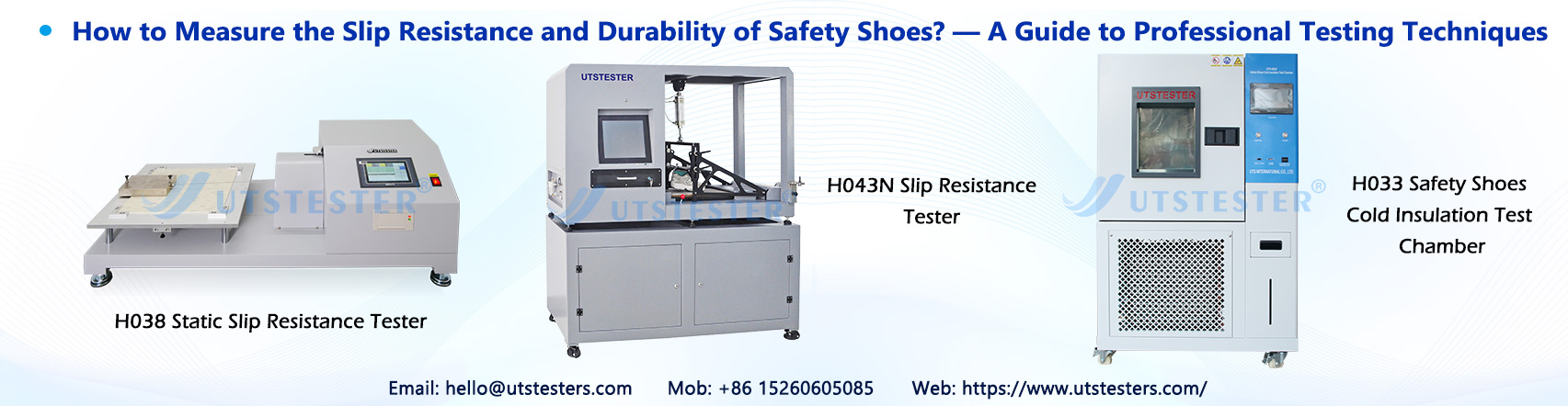
Modern anti-slip testing primarily relies on the following equipment:
1. Coefficient of friction tester: Equipped with a high-precision force sensor capable of recording changes in friction in real time
2. Inclined anti-slip tester: Compliant with ISO 13287 standards, automatically adjusts the incline angle
3. Environmental control chamber: Ensures testing is conducted under standard temperature and humidity conditions (23°C ± 2°C, 50% ± 5% RH)
II. Durability Testing: Assessing the “Longevity” of the Outsole
2.1 Abrasion Resistance Testing—The “Marathon” for Outsole Materials
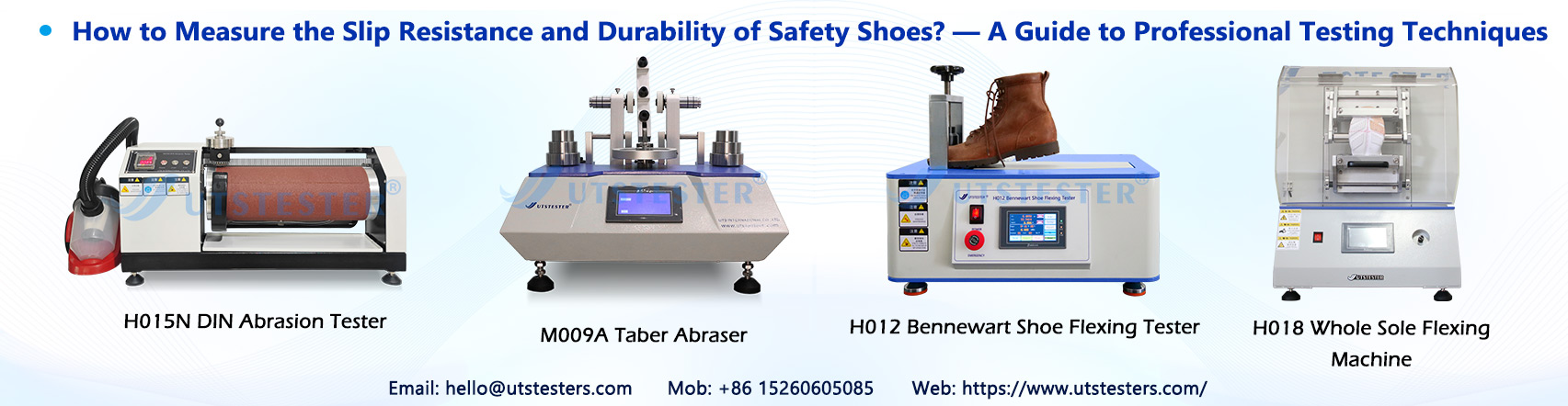
Abrasion resistance is a key indicator for measuring the service life of outsole materials. In accordance with the GB/T 3903.2-2008 and ISO 4649:2017 standards, the rotating drum abrasion test method is primarily used.
XM Abrasion Method (GB Method)
This is the most commonly used method in Chinese safety shoe testing:
Test Parameters:
- Abrasive wheel specifications: Diameter (20±0.1) mm × Width (4±0.1) mm, 72 teeth, T12 steel
- Abrasive wheel speed: (191±5) r/min
- Test load: 4.9 N
- Test duration: 20 minutes of continuous abrasion
Result classification:
- First-class product: Abrasion mark length < 10 mm
- Acceptable product: Abrasion mark length < 13 mm
DIN Abrasion Test (DIN 53516)
Widely used for testing rubber soles:
- A rotating abrasive wheel is used to rub the test specimen under a specific pressure
- Test results are expressed as the volume of material removed (mm³)
- Standard shoe soles are considered合格 if wear volume ≤ 100 mm³/1.61 km
- Safety shoes have stricter requirements, typically ≤ 80 mm³
Taber Abrasion Test (ASTM D3884)
Suitable for various sole materials:
- Uses a Taber abrasion tester equipped with an H-18 or CS-17 wheel
- Test cycles are typically 1,000 or customizable
- Evaluates mass loss or changes in thickness
2.2 Flex Resistance Testing — Simulating Walking Fatigue
Soles undergo repeated bending during walking; flex resistance testing simulates this process:
Test standards: ISO 17707, EN ISO 20344
Test Procedure:
1. Secure the sole specimen to the flexing tester
2. Perform repeated flexing at a specific angle (typically 90°) and frequency
3. The test cycle typically consists of tens of thousands of cycles (e.g., 30,000 or 50,000 cycles)
4. Inspect the sole for cracks, fractures, or delamination
Passing Criteria: No through cracks in the sole after testing; peel strength retention ≥80%
2.3 Full Shoe Durability Testing — Real-World Simulation
In addition to material-level testing, full shoe testing better reflects actual usage conditions:
SATRA TM144 Full Shoe Abrasion Test (EU CE Certification Requirement):
- Simulates human walking with a 10 km continuous walking test
- Post-test requirements: Sole tread depth ≥ 1 mm, and slip resistance (COF) ≥ 0.4
- Applicable for professional certification of safety shoes and protective footwear
ISO 20344 Full Shoe Abrasion Test:
- No sole exposure after 20 km of walking
- Thickness retention rate ≥ 70%
III. How to Select the Appropriate Testing Solution?
Select test items based on the intended use of the footwear
1. Kitchen/Food Industry: Focus on slip resistance on oil-water mixed surfaces
2. Construction Sites: Emphasize abrasion resistance and puncture resistance
3. Electronics Workshops: Require additional anti-static and ESD testing
4. Cold Storage/Low-Temperature Environments: Include low-temperature flexing and slip resistance testing
Email: hello@utstesters.com
Direct: + 86 152 6060 5085
Tel: +86-596-7686689
Web: www.utstesters.com

Room 312, Block D, Jiayuan Garden, No.2 Zhongfa Road, Zhangzhou City, Fujian Province, China

+86 152 6060 5085

+86 596 7686689


 hello@utstesters.com
 hello@utstesters.com
 +86 152 6060 5085
 +8615260605085