


 +86 152 6060 5085
 English
 русский
 español
 português
 العربية
 Polski
- Home
- Products
- News
- Blog
- Customer Cases
- About Us
- Contact Us
Blog
Catalog
Latest Blog
In the textile industry, color fastness is one of the core indicators for measuring textile quality, directly affecting a product’s durability, safety, and market competitiveness. Common consumer complaints such as “clothes fading after a few sun exposures” or “clothes staining the skin after sweating” are essentially problems caused by substandard colorfastness. Among these, lightfastness and perspiration fastness tests—as the two tests most closely aligned with real-life usage scenarios—are key focuses for textile companies in quality control and compliance testing.
I. Definitions of Lightfastness and Perspiration Fastness Tests
The essence of colorfastness lies in a textile’s comprehensive ability to maintain its original color stability under physical, chemical, and environmental stresses. It is not merely a matter of whether the color “fades or not”; rather, it reflects the quality control standards across the entire supply chain, including dyeing and finishing processes, fiber structure, and the formulation of auxiliaries. Lightfastness and perspiration fastness tests specifically address the two core usage scenarios of “outdoor light exposure” and “skin-contact perspiration erosion.”
1. Light Fastness Testing
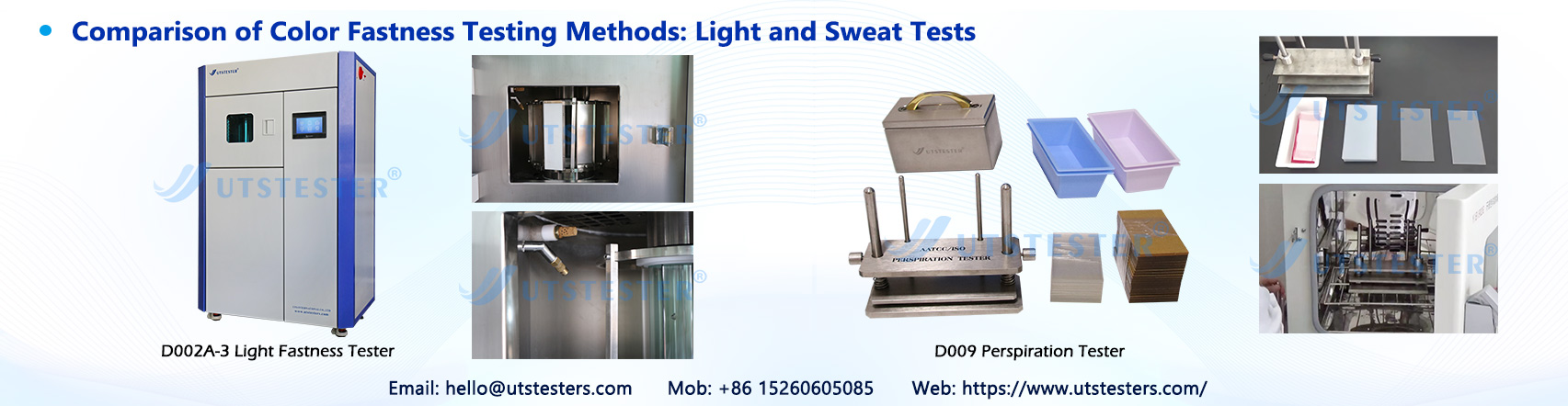
Light fastness (also known as light resistance) simulates the usage conditions of textiles under natural light, evaluating the stability of dyes when exposed to light (especially ultraviolet rays) to determine whether the textiles will fade, yellow, or discolor after prolonged exposure to sunlight. Whether it’s outdoor apparel, curtains, tents, or automotive interior fabrics, all face prolonged exposure to sunlight.
The testing logic is as follows: by artificially simulating the solar spectrum, the aging effect of light on textiles is accelerated. The color changes in the textiles before and after testing are compared to quantify their resistance to light fading. It is worth noting that different fibers and dyes exhibit significant variations in light resistance. For example, synthetic fabrics generally have better lightfastness than cotton fabrics, and anthraquinone dyes demonstrate significantly stronger lightfastness than certain azo dyes.
2. Sweat Fastness Testing
Sweat fastness (also known as resistance to sweat) focuses on the corrosive effects of human sweat on textiles. It simulates the chemical reactions that occur when worn next to the skin, where salts, proteins, and acidic or alkaline substances in sweat interact with textile dyes, leading to fading and color transfer issues. For intimate textiles such as underwear, sportswear, and socks, sweat fastness not only affects the user experience but also relates to safety—when color fastness is insufficient, dye molecules may be absorbed through the skin, posing health risks.
The testing methodology involves soaking textiles in artificially formulated acidic and alkaline sweat solutions (simulating the composition of human sweat under different physiological conditions), allowing them to stand under simulated body temperature and pressure, and then evaluating the degree of discoloration in the textile itself, as well as the extent of dye migration onto adjacent fabrics. This process determines the textile’s resistance to sweat-induced degradation.
II. Test Principles, Standards, and Key Operational Points
Although both tests fall under the category of colorfastness testing, they differ significantly in terms of test principles, applicable standards, and operational procedures. A thorough understanding of these details is crucial to ensuring accurate and compliant test results.
(I) Light Fastness Testing
1. Testing Principle
A xenon arc lamp is used to simulate natural sunlight (D65 standard light source). Harmful ultraviolet rays with wavelengths shorter than 310 nm are removed via a filter system, and parameters such as irradiance, temperature, and humidity are precisely controlled to simulate light intensity under various usage environments. Textile test specimens are placed side-by-side with blue wool standard samples (Grades 1–8). After a specified period of artificial exposure, the color changes in the test specimens are compared with those of the standard samples to determine the lightfastness grade—the higher the grade, the stronger the resistance to light fading.
2. Standards
(1) GB/T 8427-2019 “Textiles—Color Fastness Tests—Color Fastness to Artificial Light: Xenon Arc” clearly specifies requirements for the color temperature and irradiance uniformity of xenon arc lamps;
(2) ISO 105-B02 “Textiles—Color fastness tests—Part B02: Resistance to artificial light: Xenon arc lamp” applies to products exported to the EU, Southeast Asia, and other regions;
(3) AATCC TM16 “Lightfastness Testing” emphasizes the calibration accuracy of lighting equipment and serves as a key basis for exports to the U.S. market.
3. Operational Guidelines
(1) Equipment Requirements: The color temperature of the xenon arc lamp must be maintained between 5500K and 6500K, with irradiance uniformity ≤ ±10%. Calibrate the irradiance sensor regularly and replace the xenon lamp every 500 hours to prevent light source degradation from affecting test results;
(2) Sample Preparation: Cut test specimens to a size of no less than 10 mm × 8 mm and mount them on white paper cards free of fluorescent agents. Yarn or loose fibers must be arranged uniformly. For thicker specimens, adjust the height of the blue wool standard to ensure a consistent distance from the light source;
(3) Parameter Control: Adjust the irradiance according to the product’s intended use scenario; maintain humidity at 40±5%; precisely control the black panel temperature to within ±3°C to prevent color shift deviations caused by temperature and humidity fluctuations;
(4) Result Evaluation: Compare the degree of color change in the test samples against a gray scale chart to determine the final lightfastness rating.
(II) Sweat Fastness Testing
1. Test Principle
Simulating the composition and environment of human sweat, the textile specimen is bonded to a standard backing fabric and immersed in artificially prepared acidic (pH 5.5) or alkaline (pH 8.0) sweat. The specimen is then left to stand for 4 hours at 37±2°C (simulating body temperature) and 12.5 kPa for 4 hours. The specimens are then dried in air at a temperature not exceeding 60°C. Finally, the degree of color change in the specimen and the degree of color transfer to the backing fabric are evaluated, with both indicators used to assess colorfastness to perspiration.
2. Standards
(1) GB/T 3922-2013 “Textiles—Color Fastness Tests—Resistance to Perspiration,” which specifies the formulation for acidic and alkaline sweat solutions;
(2) ISO 105-E04 “Textiles—Color Fastness Tests—Part E04: Resistance to Perspiration,” applicable to most global markets;
(3) JIS L 0844 “Test Method for Resistance to Sweat,” which imposes stricter requirements on the ionic strength of sweat and applies to products exported to Japan.
3. Key Operational Points
(1) Sweat Solution Preparation: Prepare acidic and alkaline sweat solutions strictly according to the standard formulas. The quantities of reagents such as L-histidine hydrochloride and sodium chloride must be precise. Sweat solutions must be prepared immediately before use to avoid changes in composition due to prolonged storage;
(2) Sample Preparation: Test specimens must be no smaller than 40 mm × 100 mm and must be fully adhered to the standard backing fabric. During immersion, ensure the specimen is completely saturated with sweat with no air bubbles remaining to prevent test invalidation due to localized areas not coming into contact with the sweat;
(3) Environmental Control: Testing must be conducted under standard atmospheric conditions. The temperature in the constant-temperature chamber must be maintained at 37±2°C, and the pressure must be controlled at 12.5 kPa. The static holding time must strictly adhere to 4 hours; it must not be shortened or extended;
(4) Result Evaluation: Use a gray scale card to grade the samples under standard lighting conditions. Record the test results for both acidic and alkaline sweat solutions; no indicator may be omitted.
III. Common Misconceptions
1. Application Scenarios
(1) Outdoor products (e.g., tents, awnings): Emphasize lightfastness testing, which must achieve a rating of 4 or higher to ensure the product does not fade or lose its shape after prolonged exposure to sunlight; additionally, conduct basic perspiration fastness testing to address sweating in outdoor settings;
(2) Intimate-wear products (e.g., infant and toddler clothing, athletic wear): Prioritize sweat fastness, with both acid and alkaline tests achieving a rating of 3–4 or higher (infant and toddler clothing must be ≥4) to eliminate safety hazards caused by dye migration; simultaneously ensure basic light fastness to prevent fading from daily sun exposure;
(3) High-end products (e.g., premium home textiles, branded apparel): Must meet high-level requirements for both tests—lightfastness ≥ Grade 5 and perspiration fastness ≥ Grade 4—to enhance product competitiveness and brand reputation.
2. How to troubleshoot if test results fail to meet standards?
(1) Inappropriate dye selection: For example, using azo dyes with poor lightfastness for outdoor products, or dyes with insufficient acid and alkali resistance for intimate apparel, resulting in inherently inadequate colorfastness;
(2) Defects in the dye fixation process: Insufficient use of dye fixatives on cotton fabrics or curing temperatures that do not meet standards, leading to weak bonding between the dye and the fiber, which easily causes the dye to fade under the influence of light or sweat;
(3) Conflicts with post-treatment: Functional coatings such as waterproof or quick-dry treatments react with the dyes, reducing the stability of the color layer and causing a decline in lightfastness or sweatfastness;
(4) Residues from pretreatment: Incomplete desizing leaves behind substances like starch, which form complexes with the dyes, accelerating dye leaching and affecting colorfastness.
Email: hello@utstesters.com
Direct: + 86 152 6060 5085
Tel: +86-596-7686689
Web: www.utstesters.com

Room 312, Block D, Jiayuan Garden, No.2 Zhongfa Road, Zhangzhou City, Fujian Province, China

+86 152 6060 5085

+86 596 7686689


 hello@utstesters.com
 hello@utstesters.com
 +86 152 6060 5085
 +8615260605085