


 +86 152 6060 5085
 English
 русский
 español
 português
 العربية
 Polski
- Home
- Products
- News
- Blog
- Customer Cases
- About Us
- Contact Us

Blog
Catalog
Latest Blog
Knitted fabrics, prized for their softness against the skin, excellent elasticity, and breathable comfort, are widely used in apparel, home textiles, sportswear, and other fields. Durability, as a core quality indicator for knitted fabrics, directly determines product lifespan and consumer experience. Whether it's everyday sweaters, athletic wear, or frequently used bedding sets, issues like easy tearing or deformation severely impact brand reputation. So, how can we scientifically control the durability of knitted fabrics? The burst strength tester, as a core testing device in the textile industry, serves as a crucial “defense line” safeguarding the durability of knitted fabrics.
I. What is Fabric Bursting Strength Testing?
Fabric bursting strength is typically determined through a standardized method known as the “bursting strength test.” During this process, a specified pressure is applied to a fabric sample until it ruptures. The bursting strength is then recorded as the maximum pressure the fabric withstood before failure. Of course, professional testing incorporates various methods—such as constant-speed burst, constant-pressure burst, and constant-time burst—to comprehensively evaluate a textile's burst resistance from multiple perspectives.
Higher burst strength indicates superior resistance to puncture and greater durability in applications involving pressure or impact. Fabric manufacturers utilize burst strength testing to ensure their products meet industry standards and customer expectations for quality and performance.
II. Why Does Bursting Strength Test Knit Fabric Durability?
The structural characteristics of knitted fabrics are formed by interlocking yarns, resulting in a looser structure compared to woven fabrics. In practical use, they are more susceptible to external forces such as stretching, compression, and friction, leading to localized damage like tears or deformation. For instance, the elbows of sweaters and the toes of socks are critical areas prone to damage due to excessive localized stress.
Bursting strength refers to the maximum pressure a fabric can withstand in a vertical direction before rupturing under uniform expansion. This metric directly reflects a knit fabric's comprehensive ability to resist multi-directional impacts and stretching forces. Simply put, higher bursting strength indicates greater resistance to damage during daily wear and use, resulting in superior durability. Therefore, precise measurement of bursting strength provides a core dimension for evaluating a knit fabric's long-term performance.
III. Two Most Common Methods for Fabric Bursting Strength Testing
Bursting strength testers simulate the multidirectional expansion forces knitted fabrics endure during actual use, precisely measuring critical data at the moment of bursting to provide scientific basis for durability assessment. Mainstream testing methods include pneumatic, hydraulic, and steel ball approaches. Among these, pneumatic and hydraulic methods are widely adopted for knitted fabric testing due to their high precision and broad adaptability.
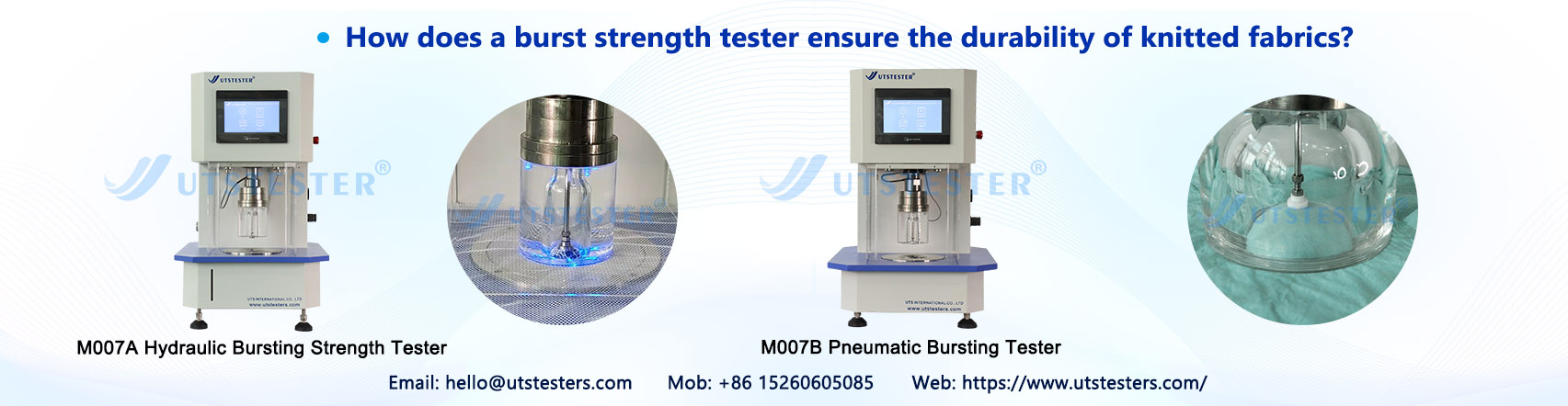
1. Hydraulic Testing Principle
A sample of specified area is clamped onto an expandable diaphragm, with liquid pressure applied beneath the diaphragm. Liquid volume is then increased at a constant rate, causing the diaphragm and specimen to expand until rupture occurs. The burst strength and burst expansion are measured.
Common hydraulic burst strength testers utilize glycerin liquid pressure to generate a lifting effect through an elastic membrane for testing.
Common relevant test standards include:
American Standard ASTM D3786, using psi as the unit;
European Standard ISO 13938-1 and Chinese National Standard GB/T 7742.1, using kPa as the unit.
2. Pneumatic Testing Principle
The sample is clamped onto an expandable diaphragm, and air pressure is applied beneath the diaphragm. The gas volume increases at a constant rate, causing the diaphragm and sample to expand until the sample ruptures. The burst strength and expansion degree are then measured.
Common relevant test methods include:
American Standard ASTM D3786, units: psi.
European Standard ISO 13938-2, Chinese National Standard GB/T 7742.2, units: kPa.
IV. Three Key Pathways for Bursting Strength Testers to Ensure Durability
Bursting strength testers play a role not only in finished product inspection but throughout the entire knitted fabric production process. From raw material selection to production process optimization and finished product quality control, they comprehensively ensure fabric durability.
1. Raw Material Selection: Eliminating Substandard Products at the Source
The durability of knitted fabrics fundamentally depends on raw material quality. Yarn strength, toughness, fineness, and other metrics directly influence the final fabric's burst strength. During procurement, enterprises can use burst strength testers to sample and inspect greige fabrics woven from different yarn batches, selecting raw materials that meet burst strength standards.
2. Production Process Optimization: Enhancing Fabric Durability
Knitted fabric production processes (e.g., knitting density, loop size, finishing techniques) directly affect structural stability and burst strength. During manufacturing, companies can use burst strength testers to evaluate fabric samples under various process parameters, identifying optimal production combinations.
3. Finished Product Quality Control: Preventing Substandard Goods from Entering the Market
Burst strength testing is an indispensable quality control step before knitted fabrics leave the factory. Manufacturers must conduct sampling inspections according to relevant standards to ensure each batch meets industry or customer specifications for burst strength.
V. Conclusion: Burst Strength Tester—The Ultimate Guardian of Knitted Fabric Durability
Amidst rising consumer expectations, demand for durable knitted fabric products continues to grow. To thrive in competitive markets, manufacturers must rigorously enforce quality standards. The burst strength tester provides scientific assurance for knit fabric durability throughout the entire process—from raw material selection and production process optimization to finished product quality control—by precisely measuring fabric burst strength.
As a specialized enterprise in textile testing instruments, our burst strength tester features a high-precision control system, multi-standard compatible design, and intelligent operation interface. It precisely adapts to various knit fabric testing requirements, delivering reliable and efficient testing solutions for enterprises.
Email: hello@utstesters.com
Direct: + 86 152 6060 5085
Tel: +86-596-7686689
Web: www.utstesters.com

Room 312, Block D, Jiayuan Garden, No.2 Zhongfa Road, Zhangzhou City, Fujian Province, China

+86 152 6060 5085

+86 596 7686689


 hello@utstesters.com
 hello@utstesters.com
 +86 152 6060 5085
 +8615260605085