


 +86 152 6060 5085
 English
 русский
 español
 português
 العربية
 Polski
- Home
- Products
- News
- Blog
- Customer Cases
- About Us
- Contact Us

Blog
Catalog
Latest Blog
Whether for textiles, electronic components, food, or pharmaceutical products, reliable protection from cardboard boxes is indispensable. Bursting strength testing, as the primary method for evaluating a box's overall performance, serves as the “key benchmark” for quality control. It not only precisely measures a box's resistance to damage but also helps identify quality risks at the source, optimize production processes, and enable enterprises to achieve comprehensive improvements in box quality.
I. What Is Carton Bursting Strength Testing?
Carton bursting strength, also known as bursting resistance, refers to the maximum uniform pressure per unit area that cardboard can withstand. It is typically measured in kilopascals (kPa) or pounds per square inch (psi). Simply put, it represents the ultimate capacity of a carton to resist rupture when subjected to external forces such as compression, impact, or tearing— — precisely the forces most commonly encountered during warehouse stacking, logistics handling, loading/unloading, and transportation.
The burst strength test principle involves a specialized testing instrument's elastic membrane. Under hydraulic pressure, the membrane uniformly expands toward one side of the carton sample, continuously applying pressure until the sample ruptures. The maximum pressure value at the moment of rupture is simultaneously recorded, enabling precise determination of the carton's burst resistance rating. Bursting strength testing focuses on the carton's “overall damage resistance,” comprehensively reflecting core indicators such as fiber strength, interlayer bonding strength, and thickness uniformity. It stands as one of the most intuitive and fundamental tests for evaluating carton quality.
II. How Does Bursting Strength Testing Enhance Carton Quality?
Bursting strength testing is not merely a “post-production inspection” tool but a “quality control lever” integrated throughout the entire carton production process. From raw paper procurement and production process optimization to finished product inspection, bursting strength testing at each stage enables precise problem identification and resolution, driving continuous improvement in carton quality.
(1) Base Paper Procurement Stage
The fiber length, fiber toughness, and grammage uniformity of base paper directly impact the box's burst resistance:
- Paper made from virgin wood pulp exhibits superior burst resistance compared to recycled pulp.
- Paper made from coniferous wood pulp demonstrates better burst resistance than broadleaf pulp.
- Longer fiber lengths and stronger inter-fiber bonding result in higher burst strength of the base paper. Concurrently, the moisture content and interlayer adhesion of base paper significantly impact burst strength. Excessive moisture content (exceeding 18%) can reduce burst resistance by approximately 10%, while poor interlayer adhesion leads to delamination and diminished burst strength. Establishing a burst resistance parameter table through testing provides data support for subsequent carton process design and paper configuration.
(II) Production Process Stages
Each stage in carton manufacturing—corrugation, laminating, creasing, die-cutting—affects the final bursting strength.
(III) Finished Product Inspection
The final quality control checkpoint before cartons leave the factory relies on bursting strength testing as its core tool.
1. For qualified batches, issue test reports to ensure compliance with standards and customer requirements, thereby enhancing customer trust;
2. For non-compliant batches, promptly investigate root causes (whether related to base paper, manufacturing processes, or storage conditions), then rework or destroy them to prevent substandard products from entering the market;
3. Simultaneously, statistical analysis of finished product test data identifies production strengths and weaknesses, forming a quality control ledger. This provides data-driven support for subsequent quality optimization, driving continuous improvement in carton quality.
III. Selecting the Right Bursting Strength Tester
The precision of bursting strength testing directly determines the effectiveness of quality control. If testing equipment lacks accuracy or involves cumbersome operations, it not only leads to data inaccuracies but also impedes quality control efficiency, potentially misleading a company's process optimization decisions.
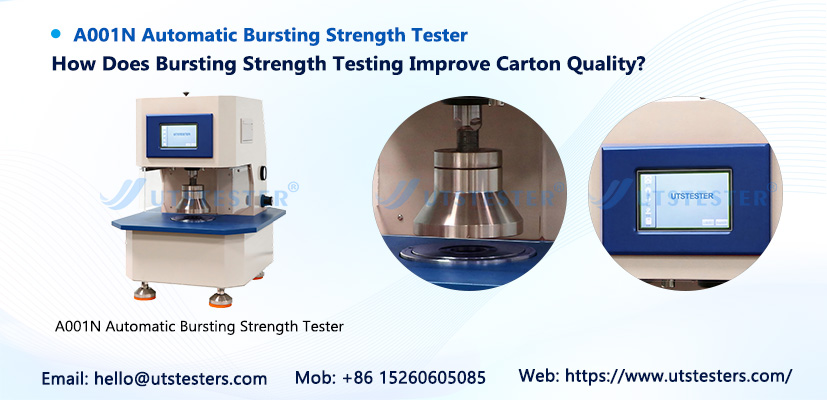
UTSTESTER introduces a carton bursting strength tester featuring high-precision sensors with outstanding linearity and exceptional stability. Pneumatic clamps enable effortless sample loading/unloading, boosting testing efficiency.
A001N Automatic Bursting Strength Tester
Application
Designed for bursting strength testing of various paper types, also suitable for non-paper materials like silk and cotton fabrics.
Features
1. Touchscreen control with Chinese/English menus and intuitive human-machine dialogue for effortless operation.
2. Built-in thermal printer for quick on-site test result printing.
3. Report statistics with real-time test curve display for visual analysis.
4. High-precision sensor with excellent linearity and strong stability.
5. Pneumatic clamping enables convenient specimen loading/unloading to improve testing efficiency.
Standards
GB/T 1539, ISO 2759, GB/T 6545
IV. Bursting Strength Testing: Driving Quality Upgrades and Industry Advancement for Corrugated Boxes
With the rapid growth of the logistics sector and escalating customer demands for packaging quality, competition in corrugated box manufacturing has intensified. Bursting strength testing has become an indispensable quality control measure for box manufacturers—not only helping businesses mitigate quality risks and manage costs, but also enabling refined production processes to enhance core competitiveness.
For enterprises in textiles, electronics, food, pharmaceuticals, and other sectors requiring substantial carton packaging, prioritizing burst strength and selecting cartons that pass rigorous testing effectively safeguards product integrity and reduces logistics losses. For carton manufacturers, emphasizing burst strength testing, optimizing production processes, and enhancing product quality earns customer trust and expands market opportunities. For testing equipment manufacturers, deepening R&D and upgrades of burst strength testing instruments to provide precise, efficient solutions will powerfully support quality upgrades in the carton industry, driving standardized, high-quality development across the entire packaging sector.
Email: hello@utstesters.com
Direct: + 86 152 6060 5085
Tel: +86-596-7686689
Web: www.utstesters.com

Room 312, Block D, Jiayuan Garden, No.2 Zhongfa Road, Zhangzhou City, Fujian Province, China

+86 152 6060 5085

+86 596 7686689


 hello@utstesters.com
 hello@utstesters.com
 +86 152 6060 5085
 +8615260605085