


 +86 152 6060 5085
 English
 русский
 español
 português
 العربية
 Polski
- Home
- Products
- News
- Blog
- Customer Cases
- About Us
- Contact Us

Blog
Catalog
Latest Blog
In industrial settings such as construction, manufacturing, and logistics, risks like falling objects and mechanical crushing constantly threaten foot safety. The compression resistance of safety shoes directly determines their protective effectiveness—non-compliant products may cause severe injuries like toe fractures due to toe cap deformation or rupture. Standardized compression testing verifies the structural integrity of the toe cap under static pressure and dynamic impact, ensuring compliance with international Personal Protective Equipment (PPE) requirements.
1. Testing Standards
ISO 20345:2021: Global baseline standard requiring static compression load ≥15kN, toe cap deformation ≤15mm, and no rupture after 60 seconds of sustained pressure;
ASTM F2413-18: Mandatory North American standard, emphasizing enhanced dynamic impact testing (200J energy absorption) with permanent deformation rate ≤3%;
EN ISO 20345:2022: EU market access standard, adding environmental adaptability testing from -20°C to 50°C.
2. Test Items
Static Compression: Simulates sustained crushing to measure maximum load capacity and residual deformation;
Dynamic Impact: 20kg impact hammer free-fall test to verify toe cap energy absorption performance;
Environmental Endurance: Temperature/humidity cycling and chemical immersion by compression performance retention testing.
3. Testing Principles and Instrument Functionality
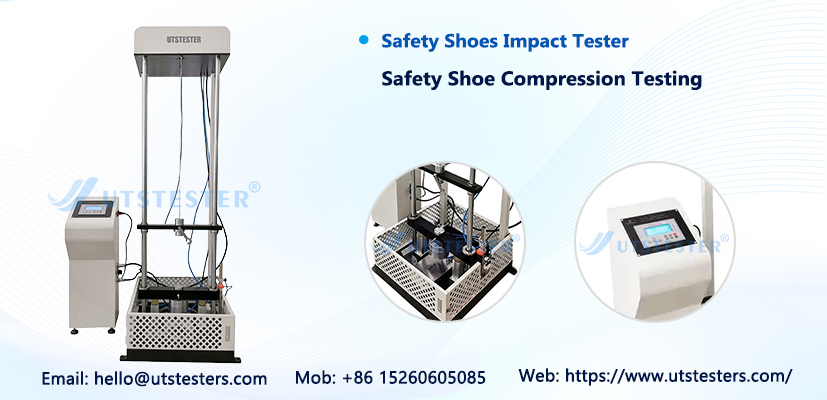
Safety shoe compression testing requires a specialized “Safety Shoe Compression and Puncture Resistance Tester”:
Sample Fixation: Secure the safety shoe with the toe cap facing upward on the test platform to simulate real-world loading scenarios;
Constant-Rate Compression: Apply pressure to the toe cap via hydraulic or electric systems at a specified rate (e.g., 10mm/min);
Data Acquisition: The instrument automatically records maximum compression force and deformation. Testing stops when pressure reaches the standard threshold or the toe cap deforms severely;
Pass/Fail Determination: Products meeting the standard's specified compression strength and residual space requirements are deemed compliant.
4. Core Significance of Safety Shoe Testing
Ensuring user safety: Prevents workplace injuries like toe fractures or contusions caused by falling objects or crushing forces;
Ensuring corporate compliance: Verifies product conformity with national/international standards, mitigating market regulatory risks;
Enhancing product credibility: Third-party test reports or factory inspection certificates serve as crucial endorsements of corporate product quality.
Email: hello@utstesters.com
Direct: + 86 152 6060 5085
Tel: +86-596-7686689
Web: www.utstesters.com

Room 312, Block D, Jiayuan Garden, No.2 Zhongfa Road, Zhangzhou City, Fujian Province, China

+86 152 6060 5085

+86 596 7686689


 hello@utstesters.com
 hello@utstesters.com
 +86 152 6060 5085
 +8615260605085