


 +86 152 6060 5085

 English
 русский
 español
 português
 العربية
 Polski

- Home
- Products
- News
- Blog
- Customer Cases
- About Us
- Contact Us
Hot Products
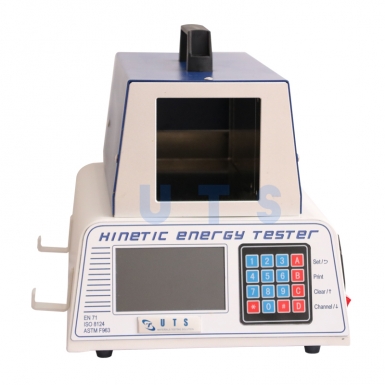
T011 Kinetic Energy Tester is used to test the maximum energy produced from projectile toy shoot bullets or launched bows, so as to evaluate ejection articles will cause injury for children or not.
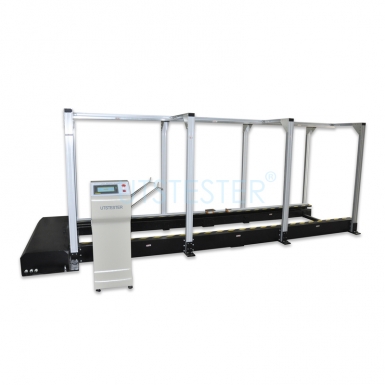
T012 Dynamic Strength & 2m/s Tester is used test dynamic strength for wheeled ride-on toys. Simulate children wheeled ride-on toys vertically crush the inelastic step 50 x 50 mm at the stable speed of 2m/s±0.2/s, and then check the damage degree. This device can be used for children ride-on toys, such as children tricycle, toy bikes, scooters, etc.
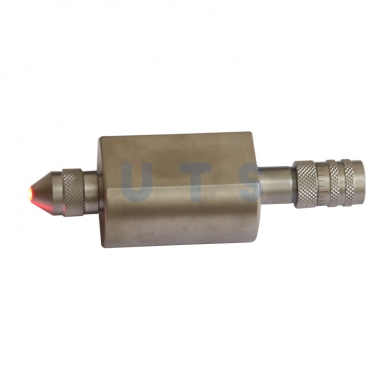
Sharp point tester is to determine whether accessible sharp points on child-related products are likely to cause injury. If the accessible sharp point penetrates a specified depth into the small rectangular opening of the tester, the LED is illuminated to indicate that the point is unacceptably sharp.
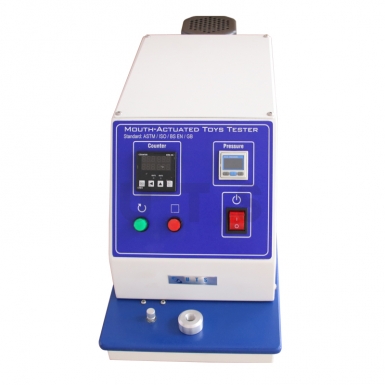
Used to test the safety of the Mouth-Actuated Toys, such as whistles with a ball, the sounders with a reed and other toys. Load the mouth-actuated projectile toy with the intended projectile and apply a pressure of 13,8 kPa ± 5 % in the direction of the mouthpiece for 5 s. Carry out the test 10 times in total.
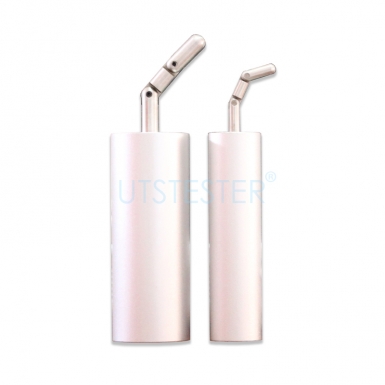
Accessibility Probe is used to assess the surface or components (points and surface of toys) of toys is likely to be touched and lead to hazardous. If the probe contacts the part or component, the part or component is considered to be accessible. Therefore, to do related tests based on standards to decrease hazards for children. This tools are including 2 parts: Probe A and Probe B. An accessible point for a toy or article intended for children 3 years of age or less is one that can be contacted by any portion forward of the collar of the accessibility probe designated as Probe A . An accessible point for a toy or article intended for children over 3 years of age is one that can be contacted by any portion forward of the collar of the accessibility probe designated as Probe B . An accessible point for a toy or article intended for children of ages spanning both age groups is one that can be contacted by any portion forward of the collar of either Probe A or B.
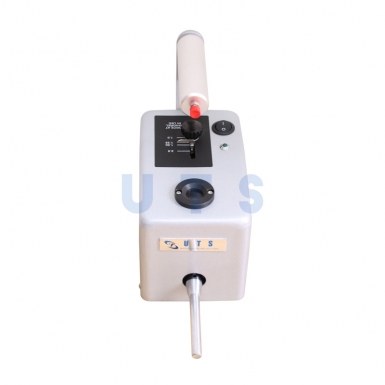
T001 Sharp edge tester is used to determine whether the accessible edges on child-related products are likely to cause potential risk of injury after normal use and reasonable abuse. Those child-related products include metal or glass edges on toys and other articles intended for use by children under 8 years of age.
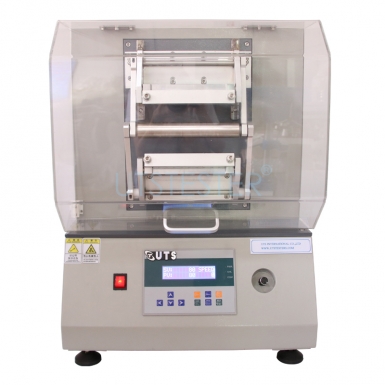
H018 Whole Sole Flexing Machine, to measure the material's resistance to incision elongation(cut growth) during repeated flexing, especially for outsoles of protective footwear, including soles. The machine has three vertical or horizontal stations available for customized and is easy to operate. Loading, unloading and measurements are also much easier to carry out with the workstations provided. The sample flexes at speed of 140 times per minute, and the exact number is recorded in a counter that has been preset to the required number of flexing. A fixture can be used to position the steel chisel, which can be used to support the sample after the initial chipping. All mobile parts that need access are fully protected with a fully interlocked security cover to ensure that the machine complies with the latest security regulations. A manual device can be used to measure the hardness of the outer bottom and check whether the outer bottom must be twisted in accordance with EN ISO 20344. UTS also provide a version of this machine for testing at low temperatures allowing tests to be conducted down to -20°C.
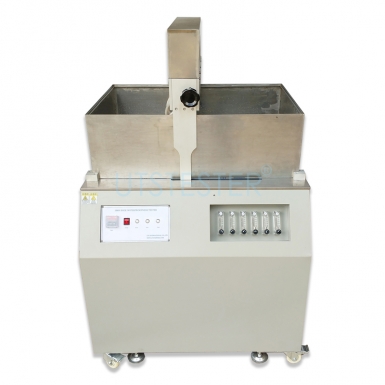
To determine the waterproofness property for finished shoes. Within the specified depth of water, whole shoe will be mechanically brushed by rotary wet brush, so as to measure the water penetration property for finished shoe.
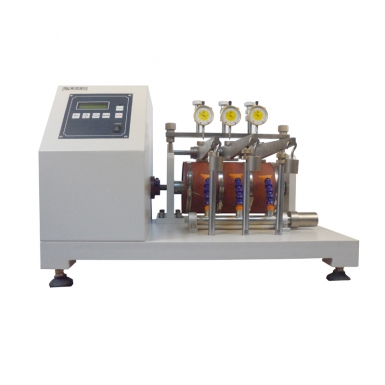
To determine the abrasion resistance property for rubber or other compounds, sole and heel materials which are not less than 2.54mm in thickness. This machine has memory function so that users can set the number of tests by themselves. The current records will be kept not to change even if power failure or stop occurs. It also can be connected to a cleaner for easy cleaning.
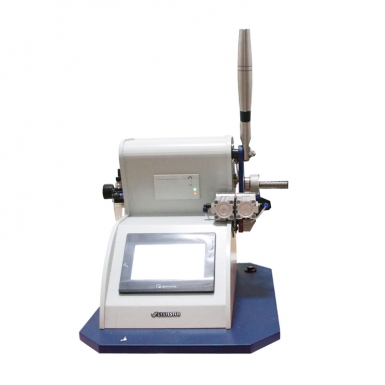
To determine the tearing resistance strength (Elmendorf method) for various textiles. Also available for thick paper, plastic cloth and electrical insulating tapes. Three interchangeable pendulums ranging from 16,000 to 128,000 Millinewtons (mN) can be selected separately for multiple test method compliance.

To determine textile damaged area and length at 45 degree condition and the times of touching flame when textile is melted to specified length after heated at 45 degree condition. Stainless steel test cabinet with glass observation panel provided with automatic timing of flame spread in 0.1 second increments from ignition. Automatic or manual flame impingement for 1,5 or 20 seconds.

To determine water vapor permeability (waterproofing and moisture-penetration performances) for various fabrics (including moisture permeable coated fabrics) and Non-woven fabric for garment usage including bat wool, space cotton, etc.
Latest news

Recently, the 2026 EXINTEX International Textile Exhibition in Mexico successfully concluded at the Puebla International Convention and Exhibition Center. As Mexico’s largest and one of Latin America’...

UTSTESTER Notice: National Day Holiday Arrangement Dear valued customers and partners, We would like to inform you of our National Day holiday schedule. Our office will be closed from Oct 1 to Oct 7, ...
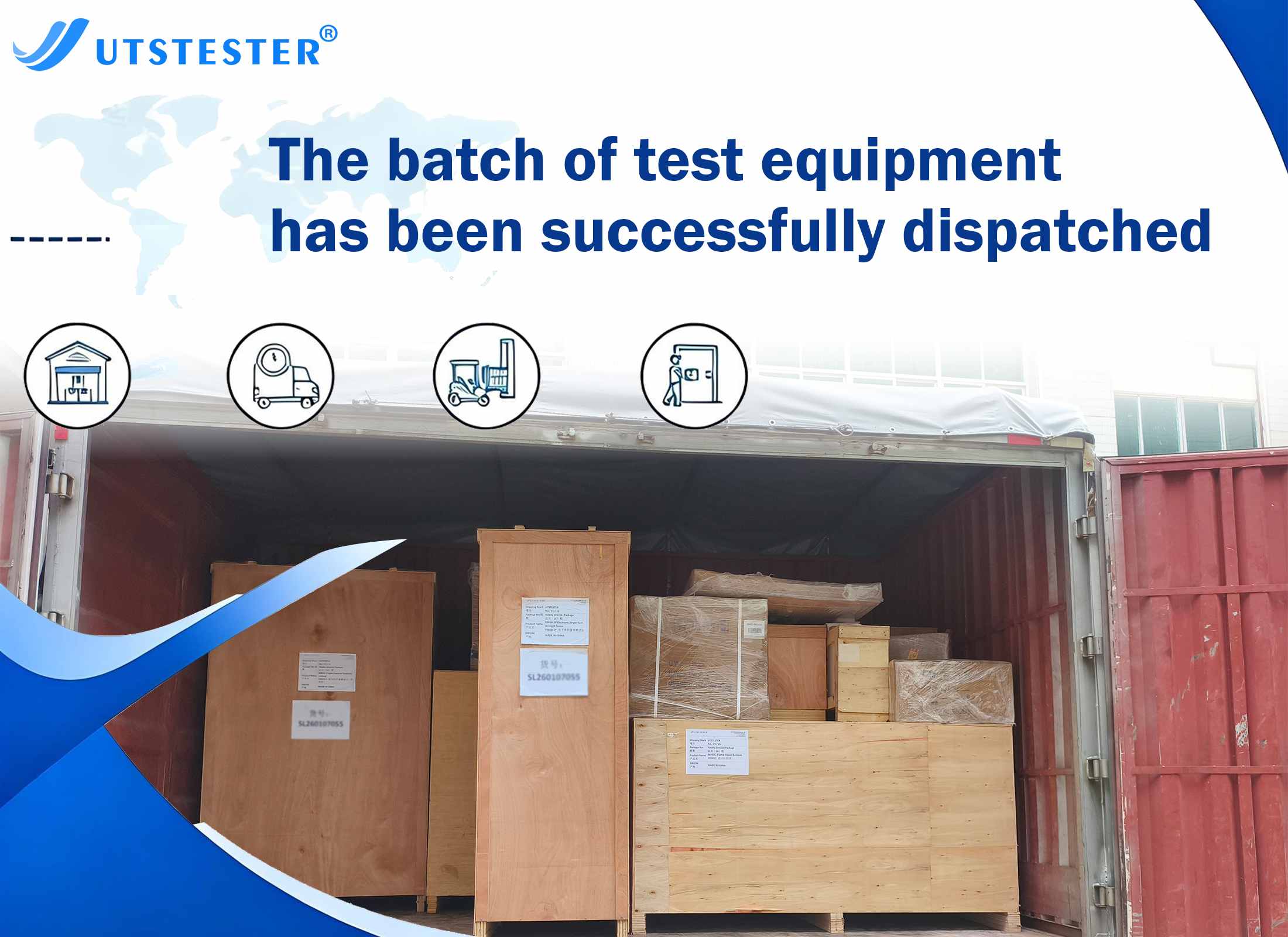
Recently, UTSTESTER completed the factory acceptance testing and loading of a batch of textile testing instruments. The equipment has been officially shipped to the customer’s designated location and ...
2019-11-13
What is the first impression of wool?
It is pierced, not skin-friendly, the fabric is too thick, not suitable for the baby to wear.
But you know what?Wool can also be divided into many types, and good wool may be softer than clouds.
Today we will take you to understand the detailed knowledge of wool products.

1. Birth of Wool
A 1905 painting shows Tibetan residents turning wool
Archaeological evidence found at sites in Iran indicates that the use of wool may have begun around 6000 BC, with wool being introduced to Europe at the beginning of the 4th century BC.By the end of the 14th century, with the trade, Italy gradually became the leading country in the international wool market.
The merino, on the other hand, originated in 8th century Spain, where the locals saw the beauty of merino wool.In the late 18th century, Spain abolished a ban on the sale of sheep, and the merino sheep, a prized breed, was able to cross the ocean to Australia.
▲ Loro Piana's merino sheep, created in collaboration with Australian ranches
After that, farmers in Australia and New Zealand took sheep raising as the basis and took the production and export of high-quality wool as the main driving force of economic development.
Also, the best wool is produced in Australia, where most wool is sold in classified auctions to help get better quality wool fibers.Loro Piana, a well-known brand of wool products, has established a strong partnership directly with Australian pastures to produce more fine and high-quality wool.Merino wool produced in this way is also known as "The Gift Of Kings®".
In 2016, China has surpassed Australia as the largest producer of wool. The inner layer of wool collected from young goats living in northern China and Mongolia is world class cashmere.Cashmere is a kind of wool fiber, which has been produced in Kashmir of Asia for thousands of years. It is also the earliest place in history where precious goats were found.
2. You know what?Different sheep produce different wool
Bring Hircus small goat
Cashmere -- Cashmere especially refers to Cashmere, which is a thin layer of wool closest to the root of the coarse hair on the goat's body.
▲ merino sheep
Merino Wool -- Merino actually comes from the breed name of sheep, the Wool produced by Merino sheep, collectively known as Merino Wool.
▲ ordinary goat
Common Wool -- common Wool has many kinds, without specific name, unified called Wool.
▲ Angora goats
Mohair -- the hair that Angora goats wear.
Bring about alpaca
Alpaca -- natural fibers harvested from alpacas.And so on...
In this article, CHAOKIDS will focus on a few types of wool fibers that are suitable for your baby.
3. Why are the prices of different wool different?
The quality of wool depends on the diameter of the fiber, i.e. fineness, crimp, color and strength, but fineness is the most important factor in determining the price and quality of wool.
The fineness of wool is divided into microns, and all fibers under 25 microns can be used to make clothes. The smaller the value, the higher the count of quality (the highest count of wool of various fineness is called the count of quality), and the softer and more valuable the yarn will be.
In microns,
< 15.5 microfiber
15.6 -- 18.5 super grade fibers
18.6 -- 20 superior fibers
20.1 -- 23 medium fibre
> 23 tough fibers
Cashmere can reach the smallest 14~16 microns in animal fibers.
Merino wool is the most fine and light wool that can be obtained on the sheep except cashmere, generally under 24 microns.Divide into different count according to wool thickness, qualitative count is in 60 above, the finest can reach 80, belong to exceed fine wool.
The micron number of common wool is in 21 micron above commonly, count also greatly inferior to merino wool.
Crimp also corresponds to the fineness of wool fibers and is used as an important basis for evaluating wool quality.
Because the fibers curl, the wool products have more volume, allowing them to breathe through the gaps between the fibers, and the fabric can trap heat.
Fine wool like merino can have up to 100 curls per inch.
If the yarn is made of wool with a neat and uniform curl, it will feel like a cloud, which is very fluffy and elastic.
Because the surface of the fiber is covered with scales, it will affect the wool's ability to reflect light. The thinner the wool, the weaker the ability to reflect light, so the luster is softer.The thicker the wool, the stronger and brighter the luster.
Cashmere is the finest fiber, so it made of clothing, the more natural luster.
Strength refers to the ability of the fiber to resist fracture, and elongation refers to the length increased due to the action of fracture force.
Each kind of wool has a different breaking strength.
Under the same type of wool, the finer the wool, the smaller the strength, and the thicker the wool, the greater the strength.
The elongation of wool is high, the elongation can reach 20~50% in general, so the higher the elongation of wool, the better the wear resistance of finished products.
4. Wool choice
A. "soft gold"
Cashmere is the most luxurious fiber that can be obtained from sheep.
Although cashmere is also classified as wool, but compared with ordinary wool, cashmere is more slender, softer, thinner and softer, so it is especially suitable for making into close-fitting clothing to wear, and cashmere has a high natural curl, heat preservation performance is basically 1.5 to 2 times of wool, light and soft, very comfortable.Known as "soft gold".
Cashmere, however, is mostly short and delicate, allowing little wear.Therefore, appropriate attention should be paid to protection when wearing, in order to extend the life of cashmere products.
At present, China is the largest producer of original cashmere, but the global annual output of cashmere is only about 7,000 tons. Limited supply of raw materials and annual rising customer demand have also contributed to the high price of cashmere.
Therefore, the budget is enough treasure mother, the most recommended start is cashmere products, whether it is to wear the baby close-fitting sweater, or outer coat, warm enough and very light.Convenient baby can also be free movement in winter.
B. gift from Australia (Merino Wool)
It is the most valuable wool except cashmere, but not all merino sheep can produce wool suitable for clothing.
Australia's soil is home to 75 million merino sheep, but only 18 million produce wool smaller than 19 microns, which is a testament to its value.
Merino wool is an active fiber, like the second layer of human skin.
It traps heat in cold weather and transmits tiny amounts of sweat into the air on warm days. The microfiber regulates its temperature by sensing external changes in temperature.
Compared with cashmere, it is not easy to shrink the ball, easy to take care of, at the same time than ordinary wool feel more soft wag, do not stick the skin.
Merino wool is also a smart choice to give your baby a high quality of life.Although it is not as lightweight as cashmere, it is more durable than cashmere, more suitable for active babies to wear merino wool products, pants are less prone to wear, warmth and air permeability is not inferior.
C. most common (Wool)
Compared with cashmere and merino wool, ordinary wool mostly count low, feel relatively rough, poor insulation, but the price is much cheaper.
Ordinary wool is not very recommended treasure mother to choose for the baby, but compared with the above two materials, ordinary wool is more durable, in the purchase of wool sweater, can also give the baby alone with a piece of cotton clothing for the inside, let the baby more comfortable.

5.Wool care can be simple
Ordinary wool can easily become "small" if not washed carefully.Water is easy to shrink, the most reasonable way to clean is dry cleaning.It is recommended to buy a size larger than usual before purchase.Be sure to pay attention to the cleaning process so you don't get a shrunk-down sweater.
And cashmere will not shrink easily, compared to its care is a lot simpler, as long as the cashmere products on the special laundry bag can be washed machine (washing machine with special cashmere wool washing function).Note that only pure cashmere will not shrink.If you still don't trust, then you can buy common cashmere washing liquid on the market, soak for 2-5 minutes, gently squeeze, do not vigorously rub, and then remove the tile dry can be.
6. How to distinguish real wool?
Is there a pure WOOLMARK
Pure wool mark is the textile mark authorized by the international wool bureau, and also guarantees the quality and quality of wool products.
Only wool products with 100% wool content can have this pure wool mark.
Good quality cashmere sweater, feel light and smooth, ordinary wool is rough touch some people.
Generally y speaking, wool and cashmere products will have different degrees of pilling.
Because the scale of cashmere is thinner than wool, under the microscope, even light, fiber brightness, no shadow sense;And the scale of common wool is thick, transmittance is not even, downy main body feels much shadow.
Email: hello@utstesters.com
Direct: + 86 152 6060 5085
Tel: +86-596-7686689
Web: www.utstesters.com
Previous article :
UTSTESTER 2021 NATIONAL DAY HOLIDAY ADVICENext article :
Have you ever seen artificial fibers that look like penguin fluff
Room 312, Block D, Jiayuan Garden, No.2 Zhongfa Road, Zhangzhou City, Fujian Province, China

+86 152 6060 5085

+86 596 7686689


 hello@utstesters.com
 hello@utstesters.com
 +86 152 6060 5085
 +8615260605085
