


 +86 152 6060 5085
 English
 русский
 español
 português
 العربية
 Polski
- Home
- Products
- News
- Blog
- Customer Cases
- About Us
- Contact Us

Blog
Catalog
Latest Blog
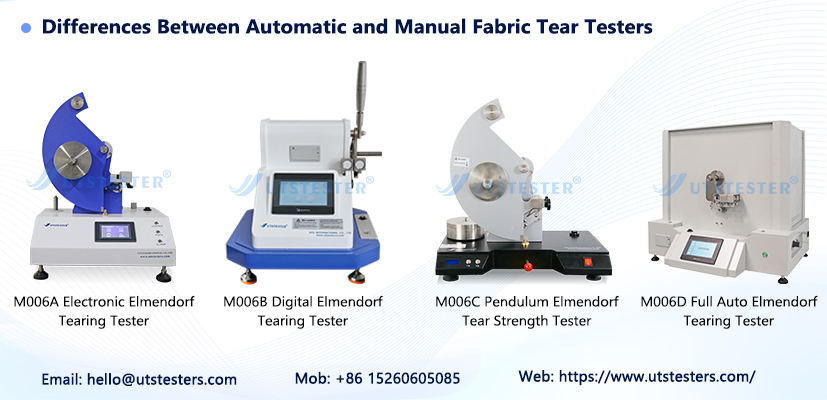
In the field of textile quality control, tear strength is one of the key indicators used to assess the durability and safety of fabrics. Whether for apparel fabrics, industrial textiles, or home textiles, tear resistance directly impacts product lifespan and consumer safety. In laboratories, the equipment used to perform tear tests—the Elmendorf Tear Tester—comes in both automatic and manual versions.
What are the fundamental differences between the automatic and manual models? Which one is better suited for your testing needs? This article will provide a comparative analysis from multiple perspectives.
I. Testing Principle
The testing principles of both types of tear testers are based on the Elmendorf pendulum method—by raising the pendulum to a fixed height (typically an initial angle of 27.5° ± 0.5°), it stores potential energy; upon release, the pendulum swings freely downward, using its own energy to tear the pre-notched specimen. The instrument calculates the force required for tearing by measuring the energy loss of the pendulum.
Automatic tear testers utilize high-precision optical encoders or angle sensors with a resolution of up to 0.1 mN. They can capture minute changes in the pendulum’s angular displacement in real time, and a microcomputer system automatically calculates and outputs the tear force value, typically achieving an accuracy of ±1% or higher.
Manual tear testers, on the other hand, rely on the operator to read mechanical scales or pointer positions, with results derived through manual conversion. Their accuracy is significantly affected by human reading errors, typically ranging from ±5% of the full scale.
II. Operating Procedures
In practical operation, the differences between the two devices are far more evident than mere numerical comparisons. Automatic fabric tear testers are typically equipped with a pneumatic automatic clamping system that secures the specimen with constant pressure, preventing slippage or deformation caused by uneven force during manual clamping. The release of the pendulum is also automatically performed by a pneumatic mechanism, ensuring that the initial conditions are identical for every test. The sample notches are also created by an automatic cutting device, with the notch length precisely controlled within the range of 20 ± 0.2 mm, meeting the stringent requirements of international standards. Upon completion of the test, data is automatically collected, calculated, and stored in the built-in system, supporting statistical analysis, trend chart generation, and report export. The entire process for a single test takes only about 10 to 15 seconds.
In contrast, every step of a manual tear tester relies on the operator’s skill and condition. The specimen must be manually placed into the fixture and locked in place, with clamping force determined solely by feel; the pendulum is released manually by the operator, with the timing and stability of the release varying from person to person; the notch is prepared using a manual cutter, which requires a high level of operational skill; and the final data must be manually read, recorded, and calculated. The random errors introduced by manual operation can increase data variability.
III. Applicable Scenarios
Automatic fabric tear testers are better suited for large textile laboratories, especially those with a daily testing volume exceeding 50 tests and requiring high efficiency and automated report generation. Since compliance with multiple international standards such as ASTM D1424, ISO 13937-1, GB/T 3917.1, the built-in multi-standard program switching function of automatic devices can significantly simplify the operational workflow. For organizations with extremely stringent requirements for testing accuracy, the high-resolution sensors and stable pneumatic systems of automatic devices provide indispensable technical assurance.
Manual fabric tear testers, however, retain unique advantages in specific fields. For small and medium-sized laboratories with low testing frequencies—fewer than 20 tests per week—and tight budgets, the cost-effectiveness of manual devices is clearly more appealing. In vocational education and training institutions, manual operation facilitates students’ intuitive understanding of the physical principles of the pendulum method—from the storage of potential energy to the release of kinetic energy, and from specimen deformation to final tear—as each physical process can be observed with the naked eye and deepened through hands-on intervention.
Email: hello@utstesters.com
Direct: + 86 152 6060 5085
Tel: +86-596-7686689
Web: www.utstesters.com

Room 312, Block D, Jiayuan Garden, No.2 Zhongfa Road, Zhangzhou City, Fujian Province, China

+86 152 6060 5085

+86 596 7686689


 hello@utstesters.com
 hello@utstesters.com
 +86 152 6060 5085
 +8615260605085